
Functions as Values in Python: Higher-Order Functions, Callbacks, and Callable Objects
Six months after the pipeline shipped, nobody can tell what the handler actually takes.

Key topics
Six months after the pipeline shipped, nobody can tell what the handler actually takes.
It gets registered somewhere, wrapped somewhere else, and passed into a dispatcher that calls it with arguments no one wrote down. When it fails, the traceback points at a line inside a closure, and the configuration that produced it lives in a cell object you cannot print. The code works. The design does not.
The weak model behind that failure is simple: "a function is just a function, so any callable is interchangeable." The stronger model is that every callable is an object with three properties you are actually choosing between — a signature, a state-ownership story, and an identity. Python first class functions give you the freedom to move behavior around like data. That freedom is also the reason you can move it somewhere no one can find it.
What "First-Class" Actually Buys You
First-class describes what you can do with a value, not how it was created. A function in Python is an ordinary object: it has a type, attributes, an identity, and you can store it, pass it, and return it. That is the whole mechanism.
def double(x):
    return x * 2

fns = {"double": double, "negate": lambda x: -x}
print(type(double))          # <class 'function'>
print(double.__name__)       # double
print(fns["double"](21))     # 42
Three creation paths produce the same kind of object: def, lambda, and the types.FunctionType constructor. The interpreter uses the constructor internally; you use def or lambda. The difference between those two is statement versus expression, not kind of object. A lambda is limited to a single expression because it is an expression itself.
The practical consequence is that behavior is data. You can put it in a dict, a list, a config object, or a queue, and dispatch on it. That is the entire foundation for higher-order functions, callbacks, and callable objects.
The trap is treating "callable" as a single type. len, a bound method, a lambda, a functools.partial, and an instance with __call__ are all callable. They are not interchangeable in signature, identity, or state. len takes exactly one argument. A bound method carries its instance as state. A partial carries frozen arguments. An instance with __call__ can carry mutable state that changes between calls. When you write a dispatcher that accepts "a callable," you have said almost nothing about what you will accept.
A closure is a nested function that carries enclosing state with it. The capture mechanics deserve their own treatment; here you only need the fact that the state travels inside the function object, not as an argument.
Knowledge check
Check your understanding
Answer this question before you continue.
Higher-Order Functions: Passing Behavior, Not Flags
A higher-order function takes a callable, returns one, or both. The mechanism is argument binding plus a call site that invokes whatever it received.
Consider the flag version first:
def process(data, mode="fast"):
    if mode == "fast":
        return [x * 2 for x in data]
    elif mode == "slow":
        return [x * x for x in data]
    raise ValueError(mode)
Every new behavior edits process. The callee owns a decision that belongs to the caller. Now the injected version:
def process(data, transform):
    return [transform(x) for x in data]

print(process([1, 2, 3], lambda x: x * 2))   # [2, 4, 6]
print(process([1, 2, 3], lambda x: x * x))   # [1, 4, 9]
The branch is gone. The callee never knows which behavior it got, and that is the point. Two call sites, two different callables, one code path.
Now you owe the reader of your code a contract. What signature must the injected callable satisfy? What does it receive? What must it return? Can it raise? An unstated callable contract is the most common source of integration bugs in this style, because the type checker sees transform and the human sees nothing.
Where this stops paying off:
- The injected callable needs more than one or two arguments. Now every call site has to agree on a shape, and the shape is invisible.
- The set of behaviors is closed and known. An enum plus a
matchstatement is more readable and more greppable than injected callables. - The behavior needs its own lifecycle — setup, teardown, accumulated state. That is a class, not a function.
Injection is a tool for open extension. It is not a default style.
Knowledge check
Check your understanding
Answer this question before you continue.
Closures and Partials: Pre-Binding Behavior
Both closures and functools.partial produce a callable with fewer required arguments. They freeze different things, and the difference decides which one you want.
A closure captures a variable from an enclosing scope. A partial freezes positional and keyword arguments at the callable's boundary.
from functools import partial

def power(base, exponent):
    return base ** exponent

square = partial(power, exponent=2)
print(square(5))        # 25
print(square.func)      # <function power at ...>
print(square.keywords)  # {'exponent': 2}
The partial preserves the underlying function's __doc__ and exposes .func, .args, and .keywords for introspection. A hand-written closure hides its configuration inside a code object. When a teammate has to debug the callable at 2 a.m., that difference is the whole story.
The mechanism difference that matters most: a closure retains access to the enclosing scope's cell, so it observes later rebinding of that name. partial binds the argument values you passed at construction time. If you build a closure in a loop and expect each one to remember its iteration value, you will learn this the hard way — and that failure gets its own walkthrough below.
One boundary worth stating precisely, because it is the source of a second class of bug: rebinding the captured name and mutating the object the name points to are different events. If a closure captures a list and you append to that list, every closure sharing the cell sees the mutation immediately. If you rebind the name to a new list, every closure sees the new binding. The cell is shared; the value inside it is whatever the name currently points to.
The classic misuse runs in both directions. Using a closure where a partial would do costs you inspectability and re-derivability of the configuration. Using partial for logic that genuinely needs a branch or a computed value forces awkward keyword plumbing that reads worse than either alternative.
The functools documentation frames partial as freezing a portion of a function's arguments to produce a simplified signature. That is the right mental model. For the descriptor case — methods defined on a class — partialmethod exists, and it behaves like partial except that it is designed to be used as a method definition rather than being directly callable. Version-dependent details, such as Placeholder support in positional arguments, should be checked against the documentation for the Python version you are actually running rather than assumed.
Knowledge check
Check your understanding
Answer this question before you continue.
Callable Objects: When Behavior Needs State and Identity
Any instance whose class defines __call__ is callable. The mechanism is ordinary method lookup on the instance's type: obj(x) is type(obj).__call__(obj, x).
class TokenCounter:
    def __init__(self, capacity):
        if capacity <= 0:
            raise ValueError("capacity must be positive")
        self.capacity = capacity
        self.tokens = capacity

    def __call__(self):
        if self.tokens >= 1:
            self.tokens -= 1
            return True
        return False

limiter = TokenCounter(capacity=2)
print(limiter(), limiter.tokens)   # True 1
print(limiter(), limiter.tokens)   # True 0
print(limiter(), limiter.tokens)   # False 0
This is a simplified token counter, not a rate limiter: it consumes one token per call and never refills. That simplification is deliberate, because it isolates the property that matters here — state that changes across calls. A real rate limiter would need a time source, and the moment you add now as a parameter you have to decide whether the caller supplies it or the object reads the clock itself. That decision is exactly the kind of thing a callable object makes visible and a closure hides.
What you gain over a closure: named attributes, multiple methods, validation in __init__, a real type you can annotate and test, and an identity that shows up in logs and tracebacks. TokenCounter(capacity=0) fails loudly at construction. A closure with a bad captured value fails silently at call time.
What you pay: more ceremony, a class that exists only to be called, and a call site that reads like a function but behaves like an object. Readers assume f(x) is cheap and stateless. Here it is neither.
The decision case is specific. A retry/backoff policy, a token-bucket rate limiter, or a stateful event handler needs mutable state across calls, plus configuration, plus a name. A closure can do all of that. A callable object makes the state visible and testable, which is usually the difference between a bug you can reproduce and a bug you can only describe.
The failure mode to name explicitly: a callable object that mutates state on every call and is passed into a concurrent or re-entrant context. The call site looks pure. It is not. Two threads sharing one TokenCounter instance will interleave reads and writes to self.tokens, and the resulting behavior depends on timing. Making an object callable does not make it thread-safe; it only makes the call syntax look like a function call. This is where the "callable is interchangeable" model does real damage — the signature looks identical to a pure function, so nothing at the call site warns you.
The functools module notes that any callable object can be treated as a function for the purposes of that module. That is useful for composition. It does not make the objects equivalent.
Knowledge check
Check your understanding
Answer this question before you continue.
Callbacks and Event-Driven Wiring
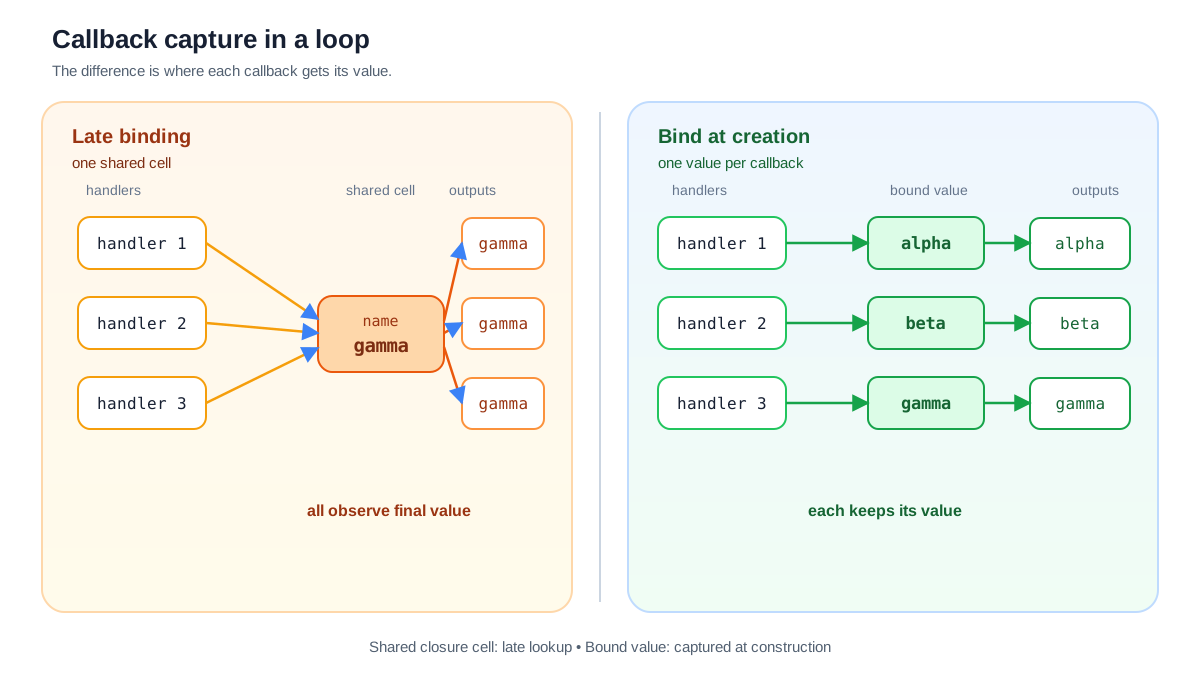
A callback is a callable stored for later invocation. The design questions are: who owns it, when is it invoked, what happens if it raises, and can it be invoked more than once or concurrently?
Signature discipline comes first. Define the callback contract once — a Protocol or a documented signature — rather than letting each registration site invent its own. Structural typing for callbacks is a separate topic; the point here is that one declared contract beats five implicit ones.
Now the late-binding bug, which is the callback failure I see most often:
handlers = []
for name in ["alpha", "beta", "gamma"]:
    handlers.append(lambda: print(name))

for h in handlers:
    h()
gamma
gamma
gamma
Every handler printed gamma. The closures captured the variable name, not its value at each iteration. By the time any handler ran, the loop had finished and name held its final value. Capture is by reference to the enclosing scope's cell.
The fix is to bind the value at construction time:
handlers = []
for name in ["alpha", "beta", "gamma"]:
    handlers.append(partial(print, name))
Or, equivalently, a default argument: lambda name=name: print(name). Both freeze the value. The partial version also stays inspectable, which matters when you are debugging which handler fired.
Error containment is the second discipline, and it is where most callback designs quietly fail. A callback that raises inside a dispatch loop can abort the remaining handlers or leave partial state behind. Decide explicitly whether the dispatcher isolates failures, aggregates them, or propagates. Here is the smallest dispatcher that makes the choice visible:
def dispatch(event, handlers, on_error="propagate"):
    results = []
    for handler in handlers:
        try:
            results.append(handler(event))
        except Exception as exc:
            if on_error == "propagate":
                raise
            results.append(exc)
    return results

def good(event):
    return f"ok:{event}"

def bad(event):
    raise RuntimeError("handler exploded")

print(dispatch("x", [good, bad, good], on_error="collect"))
# ['ok:x', RuntimeError('handler exploded'), 'ok:x']

print(dispatch("x", [good, bad, good], on_error="propagate"))
# RuntimeError: handler exploded
The same handler list produces two different outcomes depending on one policy argument. That is the point: the failure policy is a design decision, not an implementation detail. Do not assume the framework does it for you — most dispatchers propagate by default, which means one bad handler silently cancels every handler registered after it.
Bound methods are the third consideration. obj.method is a callable that carries obj as state, and it is often the cleanest option because the state has a name and a type. It also keeps obj alive for as long as the callback is registered. In a long-running system, that is a real lifetime consideration: a handler registered on a short-lived object can pin it in memory indefinitely.
Choosing Between Them: A Decision Rule
Start with the plain function. If the behavior is stateless and the signature is obvious, stop there. Most configurable behavior does not need anything more.
Then walk the criteria in order:
| Form | Use when | Cost |
|---|---|---|
| Plain function | Stateless, obvious signature | None |
functools.partial | Freezing arguments, configuration must stay inspectable | Slightly opaque call site |
| Closure | Configuration is genuinely private, created and consumed in one place | Configuration is not introspectable |
| Callable object | State across calls, validation at construction, a name in logs, multiple operations | Ceremony; call site looks pure but is not |
Five cross-cutting criteria decide the close calls:
- Signature clarity at the call site. Can a reader tell what arguments the callable takes without opening its definition?
- Where state lives and who can see it. If the state is invisible, debugging becomes archaeology.
- Testability without constructing a whole pipeline. Can you call the behavior in isolation?
- Behavior under concurrency and re-entry. Does the callable mutate shared state?
- How it appears in a traceback when it fails. Can you tell which configuration produced it?
When not to use any of this: if the set of behaviors is closed and small, an enum plus a match statement is more readable, more greppable, and easier to exhaustively test than injected callables. Injection earns its complexity when extension is genuinely open.
The Next Move
Take one place in your current codebase where behavior is selected by a flag or an if/elif ladder. Convert it to an injected callable. Before you write the implementation, write down the contract: the signature, the return value, and the failure behavior. That contract is the artifact that survives the refactor.
Then check the traceback path. If the callable fails in production, can you tell which configuration produced it? If the answer is no, the chosen callable form is hiding state you need to see. That is the signal to move from a closure to a callable object, or to a partial whose .args and .keywords you can inspect. The form you pick is not a style preference. It is a decision about what will be visible when something breaks.
Knowledge check
Final check
Finish the article by checking the ideas you just learned.
References
- On the first~classness of functions - Ideas - Discussions on Python.org
- Python’s Functions Are First-Class – dbader.org
- Have Object-Oriented Languages Missed a Trick with Class Function and its Subclasses?
- functools — Higher-order functions and operations on callable objects — Python 3.14.7 documentation
Research updated Sep 11, 2026


