
Transient vs Persistent Context: What the Model Sees and What the System Remembers
A support agent applies a customer's refund policy correctly in turn 4. In turn 9, it violates the same policy. The logs show the policy was never lost. It…

Key topics
A support agent applies a customer's refund policy correctly in turn 4. In turn 9, it violates the same policy. The logs show the policy was never lost. It was never written.
That failure is not a model failure. It is a state-design failure, and it shows up the moment you stop believing the model "remembers the conversation." A model call is stateless: it receives a payload, produces a response, and returns. Everything that survives a turn survives because your system wrote it down and put it back in front of the model.
The distinction that matters is transient vs persistent context: what the model sees for one call versus what the system stores across calls. Visibility is not persistence. Every context element has an owner, a lifetime, and a write path — and if you cannot name all three, you do not yet know how your system behaves.
Two Clocks: Per-Call View vs. Cross-Turn State
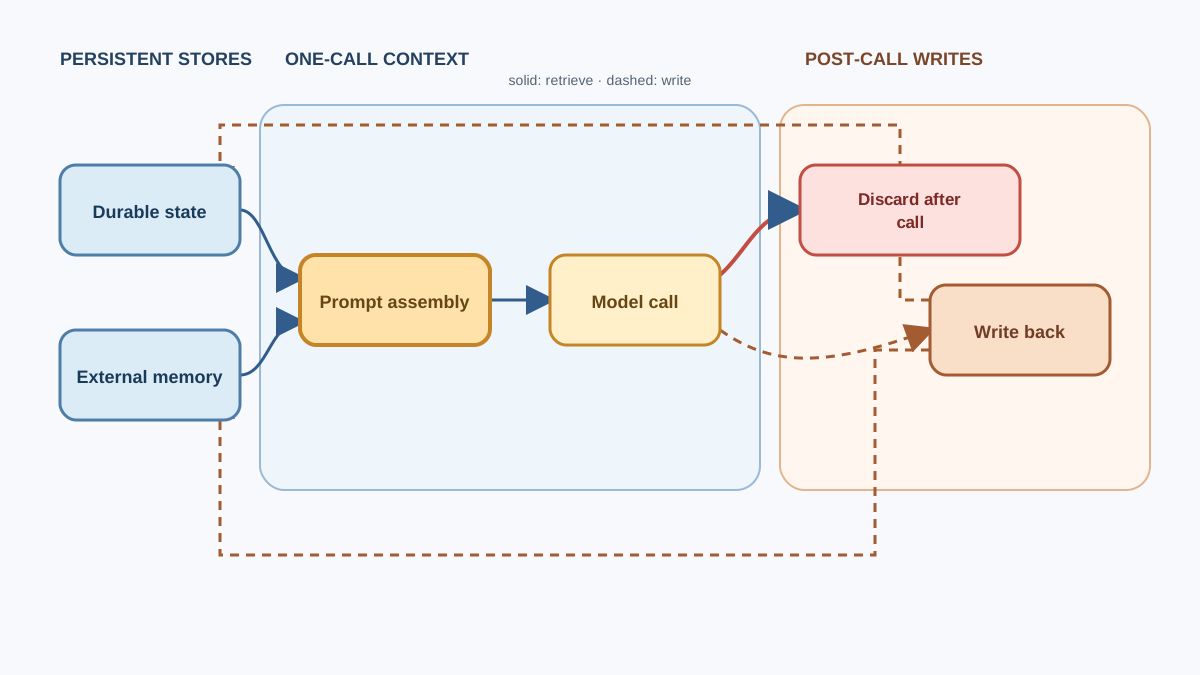
Two clocks run at the same time in any LLM application, and conflating them produces the classic "it forgot" bug.
Transient context is the assembled payload for a single model call: system instructions, selected history, tool schemas, retrieved chunks, response format. The model reads it, produces output, and the payload is discarded when the call returns. Nothing in it carries forward on its own.
Persistent context is anything the system writes down and can re-read on a later turn: conversation state, user profile facts, task progress, long-term memory stores, runtime configuration. It survives because something outside the model committed it.
The decision axis is not "important vs. unimportant." It is lifetime, ownership, and write path: who writes it, when, and what reads it back. A transient-only design loses information the instant the call ends. A persist-everything design accumulates stale, contradictory, and expensive state that quietly poisons later reasoning.
This article assumes you already treat context as a per-decision working set and know the write/select/compress/isolate vocabulary. The question here is narrower: where does each element live?
Knowledge check
Check your understanding
Answer this question before you continue.
The Three-Tier Model: Prompt, Durable State, External Memory
"Where does this go?" should be a repeatable routing decision, not a judgment call reinvented per feature. Three tiers cover almost everything.
| Tier | Persistence | Typical contents | Lifetime |
|---|---|---|---|
| 1. Prompt | Transient | Instructions, selected history, tool schemas, retrieved chunks, response format | One call |
| 2. Durable state | Persistent, session/task-scoped | Message history, task status, tool results, pending actions | Until the session or task closes |
| 3. External memory | Persistent, cross-session | Extracted facts, preferences, entity records, retrieved documents | Until invalidated |
The routing rule: write to the lowest tier that satisfies the required lifetime, then retrieve upward. Persistence you never retrieve is storage cost with no behavioral effect. A fact sitting in external memory that never gets pulled into a prompt is invisible to the model — it may as well not exist.
One asymmetry is worth internalizing. From the model's perspective, tier 1 is read-only. The model cannot persist anything by itself. Persistence is always a system-side write, whether that write comes from a tool call, a lifecycle hook, or application code. When someone says "the model remembered," they mean "our code wrote it down and read it back."
Knowledge check
Check your understanding
Answer this question before you continue.
Transient Writes vs. Persistent Writes
The same content can be injected transiently or committed persistently, and the choice changes every future turn. That is the whole mechanism.
A transient write modifies what goes into one call without touching stored state. Trimming history for a single request, adding a one-off formatting instruction, or injecting a temporary constraint are all transient writes. They are cheap, reversible, and gone next turn.
A persistent write commits to state so later turns read it back. Anything the system must honor after the current call requires a persistent write.
The cleanest contrast is history management. Trimming history for one call is transient — the stored messages are untouched, and the next call can include them again. Summarizing history and replacing the stored messages with the summary is persistent. That second move is irreversible for future turns unless you kept the original somewhere. The model now reasons from a condensed record, and every detail the summarizer dropped is gone from the system's view.
Two failure modes follow directly:
Transient fix that should have persisted. You patch behavior for the current turn, it looks correct, and it silently disappears next turn. This is the most common source of "the agent regressed" reports — nothing regressed; the fix was never durable.
Persistent write that should have been transient. A temporary instruction or speculative tool output gets baked into state and contaminates later reasoning. The model treats it as established fact because that is what the stored record says.
The practical check is blunt: for every context element, name the write path and the read path. If you cannot name both, you do not know whether it is transient or persistent — you are guessing, and production will correct you.
Knowledge check
Check your understanding
Answer this question before you continue.
What Belongs Where: A Placement Table
Here is how I route the common elements. The criterion column matters more than the placement itself, because your lifetimes will differ from mine.
| Element | Tier | Criterion |
|---|---|---|
| System instructions, safety constraints | Persistent config, injected transiently every call | Stored once, visible always; must never depend on retrieval luck |
| Conversation history | Durable state, subject to compression | Decide explicitly whether compression replaces or shadows the original |
| User preferences, stable facts | External memory, retrieved on relevance | Not worth stuffing into every prompt; retrieve when relevant |
| Task progress, intermediate results | Durable state, task-scoped | Discard when the task closes |
| Retrieved documents, tool outputs | Transient by default | Promote to durable state only when a later turn genuinely needs them |
| Scratchpads, ephemeral reasoning | Transient, usually isolated | Persisting them adds noise and false evidence |
The recurring judgment is the fourth and fifth rows. Tool outputs feel important because they were expensive to produce, but "expensive to fetch" is not the same as "needed later." Promote on demonstrated need, not on sunk cost.
Where the Boundary Breaks: Staleness, Contradiction, and Cost
Persistence introduces its own failure paths. Design for them or discover them in production.
Staleness. A persisted fact was true at write time and is now wrong. The system keeps honoring it because nothing invalidates it. This is why "persist when the information must outlive the call" comes with a second clause: it needs a defined invalidation path.
Contradiction. Durable state and external memory disagree — the session says one thing, the memory store says another. The model resolves the conflict unpredictably unless you define precedence. Pick a rule (fresher wins, explicit beats inferred, session beats long-term) and enforce it in assembly, not in hope.
Update propagation. A user corrects a fact in turn 12, but the correction never reaches the stored representation. The system answers from the outdated record. This is a write-path bug, not a retrieval bug, and it is easy to misdiagnose.
Cost and latency. Persistent context re-injected on every call is paid for on every call. A long history re-processed per request is a recurring bill, not a one-time one. This is the strongest practical argument for retrieval over stuffing: you pay for relevance, not for volume.
Model-swap discontinuity. When the serving model changes mid-session, continuity depends entirely on what the system stored. The previous model "knew" nothing that the new model inherits. This makes a model swap a useful stress test: if behavior survives the swap, your persistence is real; if it collapses, you were relying on transient state you mistook for memory.
One uncertainty note: exact behavior here depends on your framework, runtime, and model version. Treat vendor abstractions as conveniences layered over this mechanism, not as the mechanism itself. The tier boundaries hold regardless of which library assembles the payload.
When Not to Persist
Persistence is not the default good. Over-persisting is a real design error with its own failure modes.
Do not persist what you will never retrieve. It adds storage, privacy surface, and a false sense of continuity. Do not persist speculative or unverified content — draft reasoning, unconfirmed tool output — into durable state; it becomes evidence the model treats as fact. Do not persist per-request formatting or one-off constraints; those belong in the transient layer by definition.
Prefer recomputation over storage when the source of truth is cheap to re-read and staleness is expensive. A value you can re-fetch in 20 milliseconds does not need a cache with an invalidation problem.
Decision rule: persist when the information must outlive the call, cannot be cheaply recomputed, and has a defined invalidation path. Miss any of the three and you are adding liability, not memory.
Instrumenting the Boundary
State bugs are hard to debug because the evidence is split across two layers. Make the split observable.
Log the assembled prompt per call alongside a snapshot of durable state. The diff between them is where most state bugs live — you can see exactly what the model saw versus what the system held. Tag each context element with its source tier and write path, so a missing fact traces to "never written" versus "written but not retrieved." Track token cost per tier to see how much of the bill comes from re-injected persistent context.
Then add a small evaluation set of multi-turn scenarios that specifically test recall across turns, corrections after a wrong answer, and behavior after a model swap. These are the cases single-turn evals never catch.
When a "forgot" bug lands, classify it before changing code: a transient-only write, a missing retrieval, or a stale persisted value. The fix is different for each, and guessing wastes the debugging session.
Knowledge check
Check your understanding
Answer this question before you continue.
The Decision Rule
For every piece of context, name its required lifetime, its write path, and its read path. If any of the three is undefined, the design is not finished — you have a behavior you cannot predict and a bug you cannot reproduce on demand.
Pick one multi-turn behavior in a system you own. Trace where its state is written and where it is read. Then classify the last "it forgot" bug as a missing write, a missing retrieval, or a stale value — before you touch the prompt. The prompt is usually innocent. The boundary is where the crime happened.
Knowledge check
Final check
Finish the article by checking the ideas you just learned.
References
Research updated Sep 11, 2026


