
Codex Security Explained: Can an AI Agent Find, Validate, and Patch Vulnerabilities?
A scanner that flags ten thousand findings and a researcher who proves three are both "finding vulnerabilities." Only one of them has evidence you can…

Key topics
A scanner that flags ten thousand findings and a researcher who proves three are both "finding vulnerabilities." Only one of them has evidence you can re-run.
The Claim Collapses Five Different Jobs Into One Verb
"Find, validate, and patch" sounds like one capability. It is five, and they fail independently.
Discovery generates candidates: this input might reach that sink. Reproduction asks whether the input actually triggers the behavior. Validation asks whether the triggered behavior is exploitable and whether it matters in this system, with these trust boundaries. Patching asks whether the fix addresses the root cause rather than the symptom the reproducer happened to hit. Independent verification asks whether the fix holds when someone adversarial re-tests it.
Each stage should leave a different artifact:
| Stage | Artifact a skeptic can re-run |
|---|---|
| Discovery | Finding record with location and reasoning |
| Reproduction | Reproducer plus recorded execution details |
| Validation | Proof-of-concept with exploitability evidence |
| Patching | Minimal diff |
| Independent verification | Regression test, or a documented proof gap |
The compression into one verb is where false confidence enters the buying decision. A tool that owns discovery and a tool that owns validation produce the same marketing sentence and completely different triage economics.
My anchor criterion for every stage: what evidence exists that a skeptical engineer could re-run without trusting the agent's summary? If the answer is "the agent said so," that stage is a claim, not a capability.
This assumes you already run SAST, DAST, and SCA and know what each covers. The question here is narrower: which stages does an agentic AppSec tool actually own?
Knowledge check
Check your understanding
Answer this question before you continue.
Mapping the Five Stages Onto Codex Security's Three
Codex Security is OpenAI's application security agent, currently a research preview available to ChatGPT Enterprise, Business, Edu, and Pro users. It connects to GitHub repositories and runs a loop the vendor describes as identification, validation, and remediation, with revalidation after a fix merges.
The vendor's three labels and the five stages above are not the same taxonomy. Before you evaluate the product, map them explicitly, because the mapping is where capability claims get inflated.
| Article stage | Vendor stage | What the vendor bundles in | What stays unproven until you check |
|---|---|---|---|
| Discovery | Identification | Threat modeling, history scan, attack-path exploration, likelihood/impact scoring | Whether the threat model matches your real trust boundaries |
| Reproduction | Validation | Sandboxed reproduction, execution details, proof-of-concept artifacts | Whether the reproducer runs outside the vendor's sandbox |
| Validation | Validation | Exploitability confirmation before surfacing | Whether "exploitable" reflects your production context |
| Patching | Remediation | Minimal root-cause patch, surfaced for review, not auto-applied | Whether the diff addresses the bug class or the instance |
| Independent verification | Revalidation | Re-run of the original reproducer after merge | Whether the re-run is independent of the agent that wrote the fix |
Two things fall out of this table. First, the vendor's "validation" covers both reproduction and exploitability assessment, which is why the label feels stronger than either stage alone. Second, "revalidation" is not independent verification. It is the same agent re-running its own reproducer, which is useful evidence but not an external assurance boundary.
Everything below is the vendor's own account of the mechanism, not an independent audit.
Identification. After you enable a repository, the agent builds a codebase-specific threat model, scans repository history, and explores attack paths from entry point to sensitive outcome. Findings are scored by likelihood and impact, with the underlying assumptions made visible.
Validation. Before surfacing a finding, the agent attempts to reproduce it in an isolated environment. The validator records reproduction results, execution details, and proof-of-concept artifacts.
Remediation. For validated findings, the agent produces a minimal patch targeting root cause. The patch does not auto-apply. It surfaces for human review and can be raised as a pull request through your normal workflow.
Revalidation. After a fix is merged, the agent can re-run the original reproducer to close the loop.
Feedback. Adjusting a finding's criticality is described as refining the threat model and improving precision on later runs. Treat that as a vendor claim about behavior over time, not a guarantee. Precision improvements depend on your feedback being correct, which is the same assumption you were trying to avoid.
The ordering is the interesting part. Conventional SAST pipelines commonly start from rules and taint tracking. This starts from repository context and threat modeling, then attempts validation before surfacing. That is a real architectural difference, and it is also the part you should test hardest, because a threat model that is wrong in the permissive direction produces confident findings about the wrong risks.
The Threat Model Is the Real Control Surface
A threat model encodes what the system trusts, what it exposes, and what counts as a sensitive outcome. Every downstream finding inherits those assumptions. Get them wrong and the agent will be confidently, expensively wrong.
The genuinely useful property here is that the threat model is visible and editable. That makes it auditable in a way frozen rule sets are not. You can read what the agent believes about your trust boundaries and correct it.
A threat model that is wrong in the permissive direction does not produce fewer findings. It produces confident findings about the wrong risks, and the confidence is the problem.
Two disciplines follow. First, review the threat model as a security artifact with the same rigor as an architecture diagram, not as a configuration checkbox. Second, re-review it whenever trust boundaries change: new service, new auth path, new data class, new third-party integration.
Keep the distinction clean: the threat model is a representation the agent reasons over. It is not formal verification of the system's actual behavior. A correct model of a misunderstood system still produces wrong answers.
Knowledge check
Check your understanding
Answer this question before you continue.
Validation Is the Stage That Changes the Economics
Unvalidated findings push triage cost onto humans. Validated findings push it onto compute. That trade is the entire value proposition, and it is the stage most worth testing against your own codebase.
Reproduction requires an executable environment: build steps, dependencies, fixtures, and a way to observe the triggering behavior. Ask what the validator records. Execution details and proof-of-concept artifacts are what let a human re-run the claim instead of trusting it. If the output is a paragraph of prose describing a vulnerability, you have discovery with better marketing.
Edge cases that break validation:
- Non-deterministic bugs and race conditions
- Environment-specific behavior that does not reproduce in a clean sandbox
- Findings that require production data or third-party services
- Repositories that cannot be built in isolation at all
That last one is the decision boundary. If your repository cannot be reproducibly built and run in a sandbox, expect the validation stage to degrade toward static reasoning, and price the tool accordingly. A monorepo with a hermetic build and a test suite is a different product than a service that only runs against live infrastructure.
Knowledge check
Check your understanding
Answer this question before you continue.
Patching: Minimal Diff, Root Cause, and the Proof Gap
A useful patch addresses root cause, not the symptom the reproducer happened to hit. A symptom patch passes the test and leaves the class of bug open. That distinction is invisible in a green checkmark.
The strongest verification artifact is a regression test that fails before the fix and passes after it. That is a falsifiable claim about the patch, and it is the one I would demand before accepting any agent-generated fix.
One invariant to hold onto: a regression test proves a behavioral property only to the extent its execution and interpretation are trusted. It does not become independent merely because it is repeatable. If the same agent writes the fix, runs the test, and reports the result, you have self-verification with a clean log, not independent assurance. The later section on trust domains is where that distinction gets its teeth.
When a regression test is unsafe or infeasible, the honest output is a recorded proof gap plus the strongest repeatable validation artifact available. Treat a documented gap as a feature, not a failure. A tool that admits what it could not prove is more trustworthy than one that always reports success.
Verification should also check legitimate behavior and nearby bypasses, not just the original reproducer. A fix that closes one path and opens a sibling path is a regression with a green checkmark.
One operational pattern matters more than it looks: scope one finding per task or CI job. The remediation workflow is designed to be invoked once per accepted finding, passing its finding ID and scan directory. Batched patches destroy the audit trail, because you can no longer attribute a diff to a reproducer.
codex exec --sandbox workspace-write \
  'Use $codex-security:fix-finding to fix finding <id> from <scan-dir>. \
   Validate the finding, generate one minimal patch, and add a focused \
   regression test that fails before the fix and passes after it. \
   If that test is unsafe or infeasible, record the proof gap and provide \
   the strongest repeatable validation artifact instead. \
   Verify that the issue no longer reproduces.'
Verification does not close a finding automatically. Closure stays a human decision with a stated reason.
Knowledge check
Check your understanding
Answer this question before you continue.
Independent Verification Is Still Yours
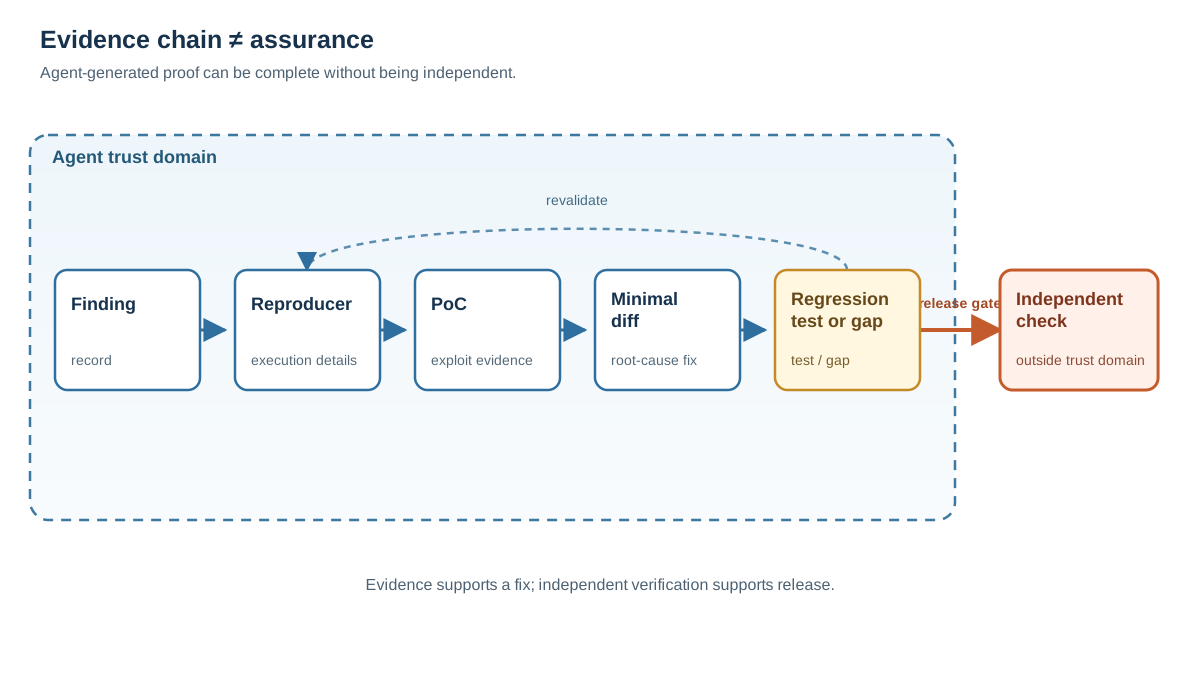
Agent verification is self-verification. The same system that proposed the fix also judges it. That is useful evidence, not independent assurance, and the gap between those two is where the expensive mistakes live.
Two failure modes deserve names. Repository artifact injection is untrusted content in README files, issues, or comments being treated as trusted task guidance. Unsupported success claims are fixes asserted as verified without sufficient execution evidence. Both are documented risks in agentic security workflows, and both are invisible if you only read the summary.
The tool's own security policy is explicit about the boundary: private scan state, workbench databases, and output directories are not separate security boundaries from your operating-system account. Plan your isolation accordingly. Repository contents, filenames, symlinks, model output, and patches are data. They do not authorize a broader scope, a different credential, or a write outside the approved output path.
Keep an independent check outside the agent's trust domain for anything that gates a release. The agent can produce the evidence; it cannot be the assurance.
Where It Fits and Where It Does Not
Strong fit: large repositories with reproducible builds, a real triage bottleneck, and a team willing to review an editable threat model and per-finding evidence.
Weak fit: systems whose behavior depends on production state, third-party services, or hardware that cannot be sandboxed; codebases with no reliable build; teams without capacity to review patches and threat-model assumptions.
It does not replace SAST, DAST, SCA, or runtime testing. Source-level discovery and validation do not cover a running system's configuration, deployment, or live attack surface. The vendor's own positioning puts it alongside existing scanning layers, not in front of them.
The cost model shifts from human triage hours to compute plus review hours. Measure both before and after rather than assuming the trade is favorable. A tool that halves triage but doubles review is a wash.
The Acceptance Matrix You Actually Run
The final experiment is one repository, one accepted finding, full evidence review. To make that repeatable across findings and across competing agents, record the result in a matrix rather than a prose verdict. The columns are the five stages, and the row is the finding.
| Stage | Required artifact | Rerun command or observation | Result | Proof gap | Independent check |
|---|---|---|---|---|---|
| Discovery | Finding record with location and reasoning | Read the finding; confirm the location exists | |||
| Reproduction | Reproducer plus execution details | Run the reproducer in your own sandbox | |||
| Validation | Proof-of-concept with exploitability evidence | Confirm the PoC reaches the sensitive outcome | |||
| Patching | Minimal diff | Apply the diff; inspect for root-cause vs. symptom | |||
| Independent verification | Regression test or documented proof gap | Run the test outside the agent's trust domain |
Fill it in for one finding before you widen scope. The empty cells are the answer to the buying question. If reproduction and validation are blank, you bought a discovery tool with a validation label. If independent verification is blank, you have evidence but not assurance.
Pick one repository. Run one scan. For a single accepted finding, demand the full evidence chain: reproducer, execution details, patch diff, regression test or documented proof gap, and a verification command you can run yourself. If any link is missing, you have learned which stage the tool does not actually own. That is the number that should drive the buying decision, not the one in the launch post.
Knowledge check
Final check
Finish the article by checking the ideas you just learned.
References
Research updated Sep 11, 2026


