
Chroma Context-1: What Is a Self-Editing Search Agent?
Hop three. The context window is full. Half of it is plausible garbage — passages that matched the query, ranked well, and turned out to be useless. The…

Key topics
Hop three. The context window is full. Half of it is plausible garbage — passages that matched the query, ranked well, and turned out to be useless. The model is now reasoning over noise it cannot unsee.
Every retrieval engineer has watched this happen. The usual diagnosis is that ranking failed. Sometimes that's true. More often, ranking worked fine and the pipeline simply never decided what to throw away.
Chroma's Context-1 is an attempt to make that decision a learned behavior instead of an infrastructure afterthought. The claim underneath it is worth taking seriously even if you never run the weights: a self-editing search agent is only as good as its pruning policy and the harness that enforces it.
The Real Bottleneck Is Context Accumulation, Not Ranking
Single-shot retrieval assumes the right next query is knowable before any results arrive. For a one-hop factual lookup, that assumption holds. For a multi-hop query — one where each hop's evidence determines what you should search for next — it breaks immediately.
The failure compounds. Turn one retrieves a passage that is topically adjacent but logically irrelevant. Turn two retrieves more. By turn three, the working set contains enough surface-level matches that the answering model has to spend capacity separating signal from decoration. Each individual retrieval call looks healthy. The episode degrades anyway.
This is context pollution, and it is a state problem, not a scoring problem. A reranker can reorder what you already fetched. It cannot decide that a document which looked relevant two hops ago has become dead weight now that the query has narrowed.
The instinctive fix — buy a bigger context window — trades one problem for two. Longer windows raise cost and latency per call, and they do not guarantee better answer quality. A larger desk does not make you tidy. It just gives the mess more room to spread.
There is a real design tension here that most pipelines resolve by accident rather than intent:
| Phase | Objective | Failure if wrong |
|---|---|---|
| Explore | Maximize recall | Miss the bridge document |
| Exploit | Maximize precision | Carry noise into reasoning |
Single-shot retrieval picks one. Multi-turn retrieval without pruning picks explore and never switches. Agentic search tries to sequence them — explore wide, then narrow hard — which requires the system to own a decision that ranking infrastructure has never been asked to make.
The invariant: retrieval quality decays across turns even when every individual retrieval call is correct. If your pipeline has no mechanism for removing state, it has no mechanism for sustaining quality.
Knowledge check
Check your understanding
Answer this question before you continue.
What Context-1 Actually Is
Context-1 is a 20B parameter agentic search model derived from gpt-oss-20B, a Mixture of Experts base. Chroma released it under Apache 2.0, trained on roughly eight thousand synthetically generated tasks.
The framing matters more than the parameter count. Context-1 is positioned as a retrieval subagent, not an answering model. Given a query, it returns a ranked set of supporting documents to a downstream frontier reasoning model. Search and generation are separated on purpose: a small specialized model does the hunting, a large general model does the synthesis.
The trained behaviors are the interesting part:
- Query decomposition into subqueries
- Iterative corpus search across turns
- Parallel tool calls, reported at roughly 2.56 per turn
- Selective pruning of its own context mid-episode
That last one is the headline. The others are increasingly common in retrieval agents.
Chroma reports retrieval performance comparable to frontier LLMs at a fraction of the cost, up to 10x faster inference, and 0.94 context pruning accuracy. Treat all of those as vendor-reported until you reproduce them. The pruning number in particular is measured against a definition of "correct prune" that lives inside the training pipeline, and that definition is doing a lot of work.
The caveat that should stop you from downloading the weights and expecting magic: Context-1 is trained to operate inside a specific agent harness that manages tool execution, token budgets, context pruning, and deduplication. That harness was not public at release. Running the model without it will not reproduce the reported results.
The Self-Editing Loop, Step by Step
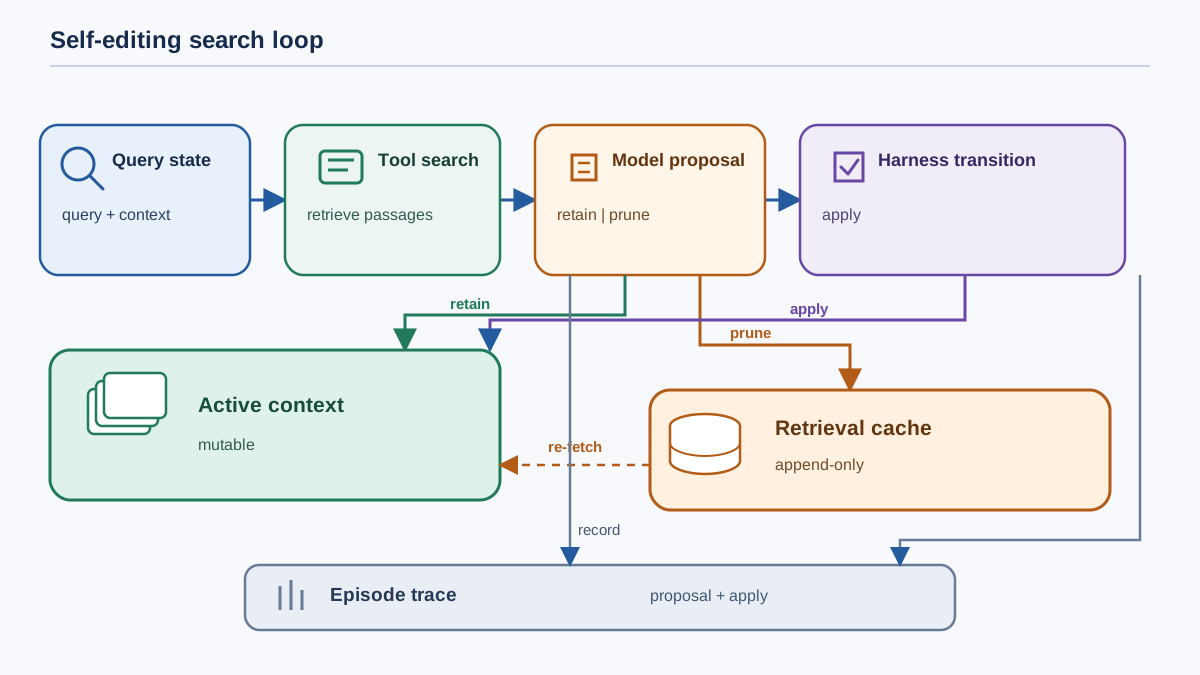
Strip the label and the mechanism is a state machine with an unusual mutation step. The critical detail is that the mutation is not a single action. It is three layers, and collapsing them is where most mental models of self-editing search go wrong.
Layer 1 — Model proposal. The policy predicts, for each passage in the active context, whether it will be useful for the remaining hops. This is a prediction about expected downstream utility, not a similarity score. A passage can be highly relevant to the current subquery and still be a candidate for removal if the policy judges that its contribution is already spent.
Layer 2 — Harness transition. The harness validates the proposal against its own constraints — token budget, deduplication rules, tool availability — and applies the resulting state change. The model does not directly mutate its context. It proposes a transition; the harness decides whether and how to execute it.
Layer 3 — Trace record. The transition is logged: what was proposed, what was applied, what the query state was at the moment of the decision. Without this layer, the policy is unauditable and failures are unattributable.
This split matters because it separates three questions that get conflated: what did the model want to do, what did the system allow, and what actually happened to the state.
State model. The agent's working set is not a single list. It is at least four distinguishable stores:
| Store | Contents | Mutability |
|---|---|---|
| Active context | Passages currently visible to the model | Prunable |
| Retrieval cache | Everything fetched this episode, addressable by ID | Append-only |
| Provenance/lineage | Source metadata, hop of origin, dependency links | Append-only |
| Episode trace | Ordered record of proposals, transitions, and query states | Append-only |
The recovery invariant follows directly: pruning may remove a passage from active context, but it must not destroy its identity or its re-fetch path. A pruned passage stays in the retrieval cache. If a later hop needs it, the agent can re-address it by ID rather than re-querying the corpus. This is what makes pruning a cache eviction rather than a deletion.
Control flow per turn. Read active context. Decide whether to decompose further. Issue one or more tool calls. Ingest results into the cache. Propose a pruning transition. Harness applies it. Trace records it. Repeat.
Termination. Some agentic search systems run a fixed number of turns. Others stop on a learned sufficiency signal. The choice changes the cost profile and the failure modes — fixed turns bound your spend but can stop early or late, while a learned signal adapts but is harder to audit.
Here is the shape of a multi-hop episode, with the three-layer split made explicit:
query: "Which supplier disclosed the same remediation timeline
        in both its 10-K and its prior-art filing?"

turn 1
  subquery: "supplier remediation timeline 10-K disclosure"
  tool calls: search_corpus(hybrid), grep_corpus("remediation")
  retrieved: [A, B, C, D]  -> cache
  proposal: retain [A, C], prune [B, D]
  harness: applied; B, D -> cache only (re-fetchable by ID)
  active: [A, C]

turn 2
  subquery: "prior-art filing remediation timeline <entity from A>"
  tool calls: search_corpus(hybrid), read_document(A)
  retrieved: [E, F, G]  -> cache
  proposal: retain [A, C, E], prune [F, G]
  harness: applied; F, G -> cache only
  active: [A, C, E]

turn 3
  subquery: "cross-reference <entity from A> with <filing from E>"
  tool calls: read_document(E), grep_corpus(entity)
  retrieved: [H]  -> cache
  proposal: retain [A, E, H], prune [C]
  harness: applied; C -> cache only (still addressable)
  active: [A, E, H]

terminate: sufficiency signal fires
return: ranked([A, E, H])
Mark what a naive pipeline would have carried forward. B and D never leave. F and G pile on. C stays forever because nothing in a reranker's job description includes deciding that a previously useful document is now dead weight. By turn three the answering model is reading eight documents to find three.
The prune at turn three is the one worth studying. C was correctly retained at turns one and two. It became discardable only after E supplied the entity that C was bridging toward. A static relevance score cannot express that. A policy conditioned on the current query state can — and because C remains in the cache, a wrong call here is recoverable rather than fatal.
Knowledge check
Check your understanding
Answer this question before you continue.
The Harness Is the Product
The model proposes. The harness constrains. Behavior depends on both, and the split is not cosmetic.
The harness owns tool execution, token budgets, pruning enforcement, and deduplication. It also defines the tool surface the policy was trained against. In Context-1's reported design, that surface includes hybrid BM25 plus dense retrieval for search, regex-style grep over the corpus, and document reads. Each tool has a different cost and precision profile, and the agent's learned preference among them is a training outcome, not a prompt.
This is where portability gets uncomfortable. If you swap in your own retrieval stack, you are changing the environment the policy was trained against. The agent learned to write queries against a fixed retrieval stack — the embedding model, reranker, and search agent were trained independently, with the agent adapting to whatever the retriever returned. Change the retriever and you have changed the ground the policy stands on. Expect degradation before you expect parity.
We have seen this movie with coding agents. Capability claims are claims about a model-plus-harness system. The weights are one input. The scaffolding is the other, and it is usually the one that determines whether the behavior transfers.
If you cannot reproduce the harness, you are running a model outside its operating envelope. That is not a reason to avoid it. It is a reason to stop expecting the reported numbers.
Knowledge check
Check your understanding
Answer this question before you continue.
How the Behavior Was Trained
The training approach is worth understanding because it tells you what the model generalizes to and what it merely fits.
Chroma used supervised fine-tuning plus reinforcement learning, with a staged curriculum that shifts the reward from broad recall toward selective precision. Explore widely first. Narrow later. The curriculum is the mechanism that produces the explore-then-exploit sequencing described earlier — it is not a prompt instruction, it is a reward schedule.
The scaling lever is synthetic task generation. An explore-verify-distract pipeline plants clues across documents and deliberately mines topical distractors: documents that look relevant but are logically useless. Distractors are the load-bearing element. Without them, a model can pass by keyword matching. With them, passing requires genuine cross-document bridging, which is what makes the pruning signal learnable in the first place.
Chroma reports domain coverage spanning web, SEC filings, patent prior-art, and email corpora, with claimed generalization to held-out domains and public benchmarks. Those are reported operating-envelope details, not architectural guarantees. They describe what the training pipeline modeled, not what your corpus contains.
Here is the honest open question. Synthetic tasks are generated by a pipeline, and the pipeline encodes a particular notion of difficulty. Benchmark performance therefore measures fit to that notion, at least in part. Cross-domain generalization claims are promising, not settled. If you are evaluating this for a domain the generator never modeled, that gap is your problem to measure, not Chroma's to assert away.
Evaluation Boundaries: What You Can and Cannot Measure
A self-editing retrieval system produces two outputs, and conflating them hides which component failed.
Retrieval quality: did the right documents reach the answering model? Answering quality: did the downstream model use them? A bad final answer can come from either. Instrument both or you will spend a week tuning the wrong half.
Four measurement rules I would hold to:
Pruning accuracy is not end-to-end quality. A high pruning accuracy can still be wrong if the discarded passage was the bridge document for a later hop. Pruning accuracy measures the policy against its own training definition of relevance. End-to-end quality measures whether the episode resolved. They can diverge.
Measure cost per resolved query, not cost per call. Fewer turns with more parallel tool calls can beat more turns with single calls, and the tradeoff only shows up end to end. A per-call cost comparison between a 20B retrieval subagent and a frontier model doing everything in one pass is close to meaningless.
Build a leak-resistant eval set. If your benchmark answers are memorizable, you are measuring recall of training data, not retrieval reasoning. Chroma's own use of synthetic generation is a response to this problem. Your internal eval needs the same discipline.
Instrument the trace. Log every prune decision with the passage, the query state, and the eventual outcome. Without that log, a bad answer is unattributable — you cannot tell whether the policy discarded the bridge document, the retriever never surfaced it, or the answering model ignored it.
Failure Attribution: Reading the Trace
The decision rule "if ranking is your problem, fix ranking" is correct but not yet executable. To act on it, you need to map a symptom to the trace evidence that identifies its cause. Here is the table I use:
| Symptom | Trace evidence | Likely cause | Intervention |
|---|---|---|---|
| Gold evidence never appears in any hop | No retrieval call returned the bridge document | Retrieval miss | Fix query formulation or index coverage |
| Gold evidence retrieved, then absent from active context | Passage in cache, prune proposal named it, harness applied | Premature pruning | Tighten prune policy; verify cache re-fetch path |
| Gold evidence retained but answer ignores it | Passage in active context at termination | Context overload or synthesis failure | Reduce active set; test answering model in isolation |
| Answer plausible but unsupported | No passage in cache supports the claim | Hallucination or retrieval gap | Add grounding check; widen retrieval |
| Episode terminates before bridge hop | Sufficiency signal fired early | Termination policy too aggressive | Audit sufficiency threshold; add turn floor |
The second row is the one that only exists in self-editing systems. It is also the one that is hardest to detect without the three-layer trace, because the failure is silent: no error, no exception, just a passage that was present and then wasn't.
Knowledge check
Check your understanding
Answer this question before you continue.
Failure Modes and Safety Boundaries
Premature pruning. The agent discards a passage that only becomes relevant two hops later. This is the characteristic failure of a learned forget policy, and it is silent. Nothing errors. The episode just resolves worse. The recovery invariant — cache retention plus re-fetch path — is what converts this from fatal to recoverable.
Irreversibility. If the edit is destructive and the source is not re-fetchable, the agent cannot recover. Keep retrieval idempotent so pruning is a cache eviction, not a deletion. The cost of re-fetching a document is almost always lower than the cost of an unrecoverable episode.
Prompt injection through retrieved corpora. A self-editing agent reads untrusted documents and then decides what to keep. That is a system where retrieved content influences control flow. Sanitize at ingestion, tag provenance per hop, and treat retrieved text as data rather than instruction. Sanitization reduces the attack surface; it does not eliminate it. The real boundary is control flow: retrieved content should never be able to alter the agent's tool permissions or termination logic.
Provenance across hops. In multi-hop or multi-agent setups, each hop may be executed by a different component. Retrieved evidence needs source metadata before synthesis, or the downstream model cannot assess trustworthiness.
Budget and termination guards. Cap turns, cap tokens, and require a sufficiency signal you can audit. An agent that decides when to stop is an agent that decides when to spend.
The safety boundary is not "can the agent prune?" It is "can you reconstruct why it pruned, and can you undo it?"
When to Use a Self-Editing Search Agent — and When Not To
Use it when queries genuinely require chaining dependent clues across documents, and when your current pipeline's failure mode is context bloat rather than ranking error. Those are two separate conditions. If ranking is your problem, fix ranking.
Do not use it when a single well-tuned hybrid retrieval plus reranker already resolves your query distribution. You would be adding a learned policy, a harness dependency, and a new failure surface for no measured gain.
Do not use it when you cannot reproduce the harness. Without the environment the policy was trained in, you are running a model outside its operating envelope and reading its output as if it were in-distribution.
The comparison that matters most is one axis: who owns the retrieval decision?
| Architecture | Decision owner | Failure mode |
|---|---|---|
| Single-shot retrieval | Your code | Misses dependent clues |
| Hybrid + reranker | Your code, scoring | Carries noise across turns |
| Agentic search | The model | Prunes the wrong thing |
Everything else follows from that column. Cost, debuggability, portability, and safety all trace back to who is allowed to change the working set.
On cost specifically: a specialized 20B retrieval subagent paired with a frontier answering model is a different cost curve than a frontier model doing retrieval and answering in one pass. Neither is obviously cheaper. Measure both on your own query mix.
The Next Move: A Paired Evaluation Protocol
Do not migrate. Instrument, then compare.
Pick ten multi-hop queries from your own logs. Run each one twice: once through your existing pipeline, once through a self-editing configuration if you have access to one. Log per-hop context state in both runs — every passage retained, every passage pruned, the query state at each decision point, and the cache contents at termination.
Then label each query with two ground-truth facts before you look at either trace:
- Oracle-needed evidence. Which passages must appear in the final active context for a correct answer to be possible?
- First-miss hop. At which hop did the baseline pipeline first fail to surface or retain a needed passage?
With those labels, score four dimensions separately:
- Bridge preservation. Did the oracle-needed evidence survive to termination? Compare baseline and self-editing.
- Context tokens at termination. How much noise did each configuration carry into the answering step?
- Turns and tool calls. Did self-editing reduce or increase the search cost?
- Final answer quality. Score the downstream answer independently of retrieval, so a synthesis failure does not masquerade as a retrieval failure.
The attribution step is what turns this from logging into evidence. For each self-editing failure, check the trace against the failure-attribution table. If the oracle-needed passage was retrieved and then pruned, you have a prune-caused failure — and you can verify whether the cache re-fetch path would have recovered it. If it was never retrieved, pruning is not your problem. If it was retained but the answer failed, your bottleneck is synthesis, not search.
That breakdown is your business case. If prune-caused failures dominate and the cache path recovers them, self-editing search is aimed at exactly your problem. If retrieval misses dominate, fix retrieval. If synthesis failures dominate, fix the answering model.
Run the paired comparison first. The attribution will tell you which architecture you actually need.
Knowledge check
Final check
Finish the article by checking the ideas you just learned.
References
Research updated Sep 11, 2026


