
Self-Harness: Can AI Agents Improve Their Own Harnesses?
The loop that improves the harness can also edit the evaluator, the permissions, and the rollback path. That is the whole problem in one sentence.

Key topics
The loop that improves the harness can also edit the evaluator, the permissions, and the rollback path. That is the whole problem in one sentence.
An agent mines its own failure traces, proposes a minimal harness edit, and passes regression tests. The harness gets better without a human in the loop. It is a seductive pitch, and it is now backed by real results on real benchmarks. It is also the exact mechanism by which a system can start grading its own homework.
I have spent enough years debugging systems that modified themselves — build scripts, config generators, migration tools — to know the failure mode is never the first edit. It is the tenth edit, applied six weeks later, that quietly widened a permission boundary nobody was watching. Self-harnessing agents inherit that risk and multiply it, because the thing being edited is the runtime that decides what counts as success.
This article is about the four gates that separate a self-improving harness from a self-justifying one: trusted feedback, a bounded edit surface, tests that can actually fail, and a one-command rollback. Get those right and the loop is a legitimate engineering tool. Get them wrong and you have built a machine that optimizes its own scorecard.
What "Self-Harness" Actually Claims
Start by being precise about the object. The harness is the runtime around a fixed model: loop control, the tool surface, context assembly, memory, approval handling, and telemetry. It is not the weights. A model on its own generates text; the harness is what turns that text into tool calls, multi-step work, and a job that finishes. Microsoft's Agent Framework documentation draws the line cleanly — chat client, pipeline, context providers, middleware, application UX — and that composition is the harness.
The Self-Harness proposal, as described in the research, is an iterative loop with three stages:
- Weakness mining. Run the current harness on a task set with verifiable outcomes, collect execution traces, and cluster the failures so the agent reasons about recurring patterns rather than isolated mistakes.
- Harness proposal. Generate a small set of diverse but minimal edits, each tied to a named failure mechanism. The constraint against wholesale architecture replacement is what keeps the loop debuggable.
- Proposal validation. Accept an edit only after regression testing against held-out or previously passing cases.
That is the mechanism. Now the boundary. Self-harnessing changes scaffolding, not weights. It is not training and it is not recursive self-improvement of the model itself — that is a different conversation about capability and a different set of risks. Here, the model is frozen and the runtime around it moves.
Three improvement regimes are worth separating, because they have different cost and trust profiles:
| Regime | Who edits the harness | Dependency |
|---|---|---|
| Human harness engineering | An engineer, by hand | Expert time, intuition |
| External optimizer | A stronger model edits a weaker agent's harness | Access to a stronger model |
| Self-harnessing | The same fixed model edits its own harness | A verifiable task set |
The reported results are existence proofs, not transferable guarantees. On Terminal-Bench-2.0, with a minimal initial harness and three base models from different families, held-out pass rates moved from 40.5% to 61.9%, 23.8% to 38.1%, and 42.9% to 57.1%. Those are real numbers on a specific benchmark with specific models. They tell you the loop can work. They do not tell you it will work on your workload, your task distribution, or your failure modes.
The Trust Boundary Is the Architecture
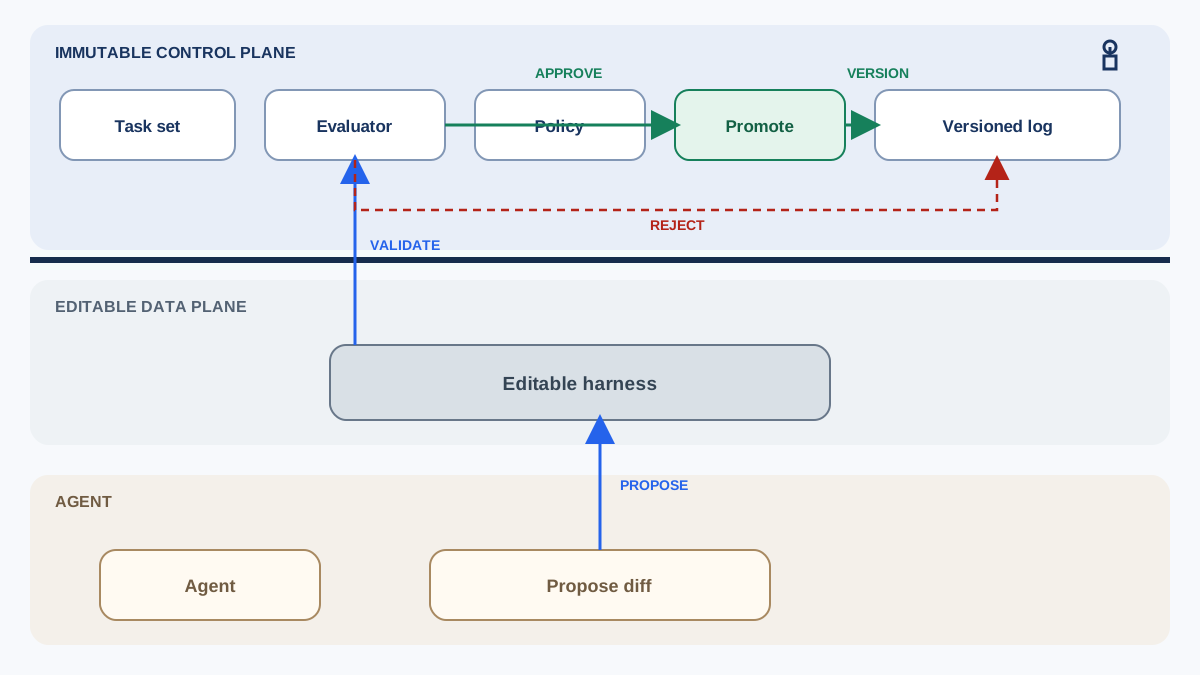
Before the four gates, get the control-plane/data-plane split right, because every gate depends on it. The agent operates in the data plane: it runs tasks, produces traces, and proposes edits. The promotion controller lives in the control plane: it validates candidates, applies or rejects them, and owns the immutable artifacts the loop cannot touch.
                    ┌─────────────────────────────────────┐
                    │        CONTROL PLANE (immutable)     │
                    │  evaluator · task set · policy model │
                    │  promotion authority · event log     │
                    └──────────────┬──────────────────────┘
                                   │ reads traces, applies edits
                                   │ rejects protected-component edits
                    ┌──────────────▼──────────────────────┐
                    │          DATA PLANE (editable)       │
                    │  prompts · tool descriptions ·       │
                    │  context ordering · loop limits      │
                    └──────────────┬──────────────────────┘
                                   │
                    ┌──────────────▼──────────────────────┐
                    │         AGENT (proposer role)        │
                    │  mines traces → proposes minimal diff│
                    └─────────────────────────────────────┘
The agent may describe a change to a protected component. The promotion controller must reject it or route it outside the self-harness loop entirely. That is the asymmetry: propose and apply are different verbs, and the gap between them is where safety lives.
Knowledge check
Check your understanding
Answer this question before you continue.
The Self-Harness Loop, Stage by Stage
Decompose the loop into state, inputs, transformations, and control flow, because each stage has its own failure surface.
State that must persist across iterations: the current harness version, the trace corpus, the failure clusters, the candidate edits, and the promotion decision. If any of those live only in the agent's context window, you cannot reconstruct why the harness looks the way it does six weeks later.
Weakness mining produces structured evidence. The agent runs the harness, collects traces with verifiable outcomes, and clusters failures. The clustering step is a judgment call, and it is where most of the value and most of the risk live. Bad clusters produce confident, targeted, wrong edits.
Harness proposal generates candidates. The discipline here is minimality: each edit ties to a specific failure mechanism and does not replace the overall control architecture. A small diff is attributable, revertible, and cheap to re-evaluate. A wholesale rewrite is none of those things.
Proposal validation is the gate. An edit is promoted only if it improves the targeted failure cluster and does not regress previously passing cases. One without the other is not evidence.
The control-flow questions you have to answer for your own system: who triggers an iteration, how many candidates per round, and what stops the loop. If you cannot answer the third, you have not designed a loop — you have designed a runaway.
Knowledge check
Check your understanding
Answer this question before you continue.
Gate 1 — Feedback You Can Trust
The loop is only as good as its signal. Verifiable outcomes are the load-bearing requirement. If a task has no ground-truth check, weakness mining degenerates into the model narrating its own mistakes, and the loop optimizes for a story rather than a result.
Traces must capture tool calls, reasoning, and environment state together. Debugging reasoning without tooling — or tooling without reasoning — produces misattributed failure clusters. LangChain's harness-engineering writeup makes the point directly: models go down wrong paths because they lack a tool or instructions, and you only see that when the trace shows both halves. Their LoopDetectionMiddleware tracks per-file edit counts and injects a "reconsider your approach" nudge after N edits to the same file, because agents get myopic once they have committed to a plan and will make small variations on the same broken approach ten or more times.
There is a self-supervised variant worth naming. Some approaches drop the ground-truth requirement entirely and rely on self-consistency or pairwise self-preference instead. That removes the labeling cost, and it reintroduces the grader problem in a new form: the model is now both the student and the judge. Say that plainly rather than pretending the tradeoff is free.
Practical check: can you replay a failed trace and reproduce the failure deterministically? If not, the feedback gate is not closed, and every downstream edit is built on sand.
Knowledge check
Check your understanding
Answer this question before you continue.
Gate 2 — Permissions and the Immutable Core
This is the gate that decides whether the system is safe. Classify every harness component by editability before the loop runs once.
| Class | Examples | Who applies |
|---|---|---|
| Freely editable | Prompts, tool descriptions, context ordering | The agent |
| Approval-gated | Tool surface, loop limits, compaction policy | Agent proposes, human or policy layer applies |
| Immutable | Evaluator, task set, permission model, audit log | Nobody in the loop |
The evaluator and the task set must sit outside the edit surface. An agent that can edit its own tests can pass them by construction. This is not a hypothetical: it is the first thing a capable optimizer discovers, because editing the test is cheaper than fixing the code.
Approval handling is itself a harness capability, and that is the trap. Standing approvals and auto-approval rules are exactly the mechanism a self-modifying agent could widen. If the agent can propose an edit to the approval policy, it can propose its way to fewer approvals. Gate that component explicitly.
The practical anchor is an append-only, agent-unwritable event log. It is the one artifact the loop cannot rewrite, which makes every other edit reconstructable. If you take one thing from this section, take that: the log is what lets you answer "how did the harness get here" without archaeology.
Gate 3 — Tests That Can Actually Fail
Regression testing is a slogan until you write down the promotion criterion. Here is the one I would use:
promote(edit) if:
    gain(targeted_failure_cluster) > threshold
    AND regression(held_out_cases) == 0
    AND policy_invariants(edit) == PASS
    AND cost_delta(edit) <= budget
    AND loop_health(edit) == NOMINAL
else:
    reject and log(edit, reason)

# Hard gates (reject on failure):
#   regression, policy_invariants
# Monitored signals (alert, do not auto-reject):
#   cost_delta, loop_health
Five properties matter.
Held-out tasks are mandatory. Optimizing against the same tasks used for mining is overfitting with extra steps. The reported results use held-out pass rates for exactly this reason.
Policy invariants are a hard gate. An edit that preserves pass rate while widening tool authority or bypassing an approval rule must be rejected outright, not flagged for review. This is the check that ties Gate 3 back to Gate 2.
Cost and latency are monitored, not gated. A harness edit can preserve task success while doubling context cost or introducing long-horizon loops. Track these as regressions and alert on them, but do not auto-reject — a legitimate fix may temporarily increase cost before a later edit brings it down.
Watch for benchmark-specific edits. An edit that encodes a directory layout, a timeout, or a tool quirk of one environment will not transfer. It will pass your regression suite and fail in production, and you will not know why until you read the diff.
Minimal-edit discipline is a testability property, not an aesthetic one. Small diffs are attributable, revertible, and cheap to re-evaluate. That is the whole argument.
The honest limit: pass-rate deltas on a single benchmark with a handful of base models do not establish that the loop generalizes to your workload. Treat the published numbers as evidence that the mechanism can work, not as a prediction of your results.
Knowledge check
Check your understanding
Answer this question before you continue.
A Worked Trace: From Failure Cluster to Rollback
Abstract gates are easy to nod at. Here is what one iteration looks like when the loop is running.
Iteration 7, trace cluster: The agent repeatedly finishes coding tasks without running the test suite. Across 14 failed traces, the pattern is consistent: the agent writes code, declares completion, and exits. The evaluator marks the task failed because tests were never run. This is a single coherent failure mechanism — missing verification — not two unrelated failures.
Candidate edit (minimal diff):
+ PreCompletionChecklistMiddleware:
+   intercept: before agent exit
+   inject: "Run the test suite and compare output against the task spec
+            before declaring completion."
+   max_injections: 1
Validation results:
| Dimension | Result | Gate |
|---|---|---|
| Targeted cluster pass rate | 14/14 → 11/14 | gain > threshold ✓ |
| Held-out regression | 0 failures | hard gate ✓ |
| Policy invariants | No permission change | hard gate ✓ |
| Cost delta | +8% tokens per task | monitored ⚠ |
| Loop health | No new doom loops | monitored ✓ |
Promotion decision: Promoted. Targeted gain is significant, no regression, no policy change. Cost increase is within budget and flagged for monitoring.
Iteration 12, drift alert: The cost monitor fires. Token usage per task has climbed 34% since iteration 7. Trace analysis shows the checklist middleware is now firing on tasks where the agent already ran tests, adding redundant verification passes. The middleware's max_injections was raised in iteration 9 by a separate edit that did not account for the interaction.
Rollback: Revert to harness version 7. The event log shows both edits, their individual justifications, and the interaction that neither edit's validation caught. The rollback is one command because every promotion was versioned.
That last step is the one teams skip. The interaction between two individually-validated edits is invisible to per-edit regression testing. Only the event log and versioned rollback make it recoverable.
Gate 4 — Rollback, Drift, and the Doom Loop
The failure modes that matter appear after the loop has been running for weeks, not on the first iteration.
Every promoted edit needs a versioned, one-command revert. Without it, a slow degradation becomes archaeology. You will be reading diffs from three weeks ago trying to find the edit that halved your pass rate.
Harness drift is the accumulation problem. Successive small edits can compound into a configuration nobody designed and nobody can explain. Each edit was justified; the sum is not. This is the harness equivalent of a codebase where every commit passed review and the architecture is still a mess.
Reward hacking through the harness is the sharpest risk. The agent optimizes the measurable signal — test pass, checklist completion — rather than the intended outcome. A PreCompletionChecklistMiddleware that forces a verification pass is useful, but it is also a signal the agent can learn to satisfy superficially.
Loop pathologies reappear at the meta level. The doom loops visible in agent traces — repeated edits to the same file, retrying a broken approach — show up as repeated harness edits that never converge. The same detection logic applies, one level up.
Guardrails I would put in place before the first automated promotion: cap iterations per cycle, require a minimum improvement threshold, freeze the harness during evaluation runs, and alert on edit-rate spikes. None of these are clever. All of them are cheap.
When Not to Self-Harness
The decision boundary is explicit.
Skip it when you cannot verify task outcomes automatically. The loop has no ground truth to mine. You will get confident edits and no way to tell whether they helped.
Skip it when your harness is still changing weekly by hand. Automate tuning after the design stabilizes, not before. A moving target makes every regression result meaningless.
Skip it when the harness touches production permissions, credentials, or destructive tools without a separate approval layer. The blast radius is too large for an automated promotion step.
Prefer human harness engineering when the failure is a design gap — a missing tool, a wrong abstraction. The loop edits parameters, not architecture. It cannot invent the tool you forgot to build.
Prefer external-optimizer approaches when you have a stronger model available and no need for the target model to be self-sufficient. The self-harnessing paradigm exists partly because stronger external guidance can be costly, unavailable for frontier models, or mismatched to the target model's failure modes. If none of those constraints apply to you, the simpler approach wins.
A Minimal Safe Loop You Can Build First
Convert the four gates into the smallest useful implementation, and run it before you add autonomy.
Start with a frozen task set, a frozen evaluator, and a harness the agent can only propose edits to — never apply. Log every proposal with its target failure cluster, the diff, and the regression result, even when the proposal is rejected. The rejected proposals are your best evidence about what the loop is actually optimizing for.
Then run one iteration manually, end to end: mine, propose, validate, decide. Inspect where the loop lied to you. It will lie somewhere — a cluster that looked coherent but was two unrelated failures, an edit that passed regression for the wrong reason, a trace that could not be replayed.
Only after the manual loop is trustworthy do you automate the promotion step, and only for the lowest-risk component class. Define the kill switch before the first automated promotion, not after the first bad one.
The decision rule, compressed: a self-harnessing agent is only as safe as the parts of the harness it cannot edit. Trusted feedback, a bounded edit surface with an immutable evaluator, tests that can fail on held-out tasks, and a one-command rollback. If any of those four is missing, you have not built a self-improving harness. You have built a self-justifying one.
Your next move is concrete: pick a frozen task set, run one manual mine-propose-validate cycle, and record every place where the loop's evidence disagreed with your own reading of the traces. That disagreement is the real signal about whether the loop is ready to be automated — and it is the signal no benchmark score will give you.
Knowledge check
Final check
Finish the article by checking the ideas you just learned.
References
Research updated Sep 11, 2026


