
Recursive Self-Improvement in AI: What Anthropic Means by “When AI Builds Itself”
A coding agent is handed a fixed training script and a fixed success metric: make it run faster without breaking correctness. It rewrites, runs, times, and…

Key topics
A coding agent is handed a fixed training script and a fixed success metric: make it run faster without breaking correctness. It rewrites, runs, times, and repeats. In May 2025, Claude Opus 4 averaged roughly a 3x speedup over the starting code. By April 2026, a later model reached roughly 52x. A skilled human researcher, for calibration, needs four to eight hours to reach 4x.
That gap is real, and it is the kind of number that gets compressed into a headline: AI builds itself. But read the setup again. The goal was fixed in advance. The success metric was fixed in advance. The agent searched inside a space someone else had drawn. That is a bounded optimization loop, not a system choosing its own trajectory — and the distance between those two things is the entire argument.
This article gives you an operational definition of recursive self-improvement you can apply to a claim, a demo, or your own agent stack, so you can tell which loop is actually closing and which one is being implied.
What “AI Builds Itself” Actually Claims
Anthropic’s own framing is a progression, not a single event. It describes three stages: AI accelerating AI development, then AI doing more of the research workflow, then AI systems capable of full recursive self-improvement and building their successors. The third stage is explicitly conditional. The source says recursive self-improvement is not inevitable, and that it may arrive sooner than organizations are prepared for.
Keep the claim and the implication separate. The claim is a trend plus a conditional: capability is rising on measurable AI-development tasks, and if that trend continues and systems develop the relevant capabilities, self-design becomes plausible. The implication — a singularity, a hard takeoff, an intelligence explosion — is a projection layered on top. The trend is measurable. The projection is not, at least not yet.
The word “self” is where the phrase gets slippery. It can refer to the model weights, the system prompt, the agent harness, the surrounding codebase, the evaluation suite, or the organization that runs all of it. A claim that “the AI improved itself” is close to meaningless until you name which of those changed. Most public disagreement about recursive self-improvement is really disagreement about which layer the speaker has in mind.
Two Axes, Not Four Peer Loops
The common mistake is to treat every kind of iteration as a peer loop. The cleaner model separates two independent questions: what artifact changes, and whether the change persists into the next improvement cycle. Evaluation is not a peer of the others — it is a cross-cutting control plane that decides whether any change counts as improvement.
| Change target | Cycle time | Evidence of improvement | Dominant failure mode |
|---|---|---|---|
| Weights (model training) | Weeks to months | Held-out benchmark deltas | Overfitting the eval; catastrophic drift |
| Prompts, code, configs, harness | Minutes to hours | Task success rate, cost, latency | Plausible diffs that fix nothing |
| Evaluator (the definition of “better”) | Hours to days | Agreement with human judgment | Reward hacking; eval rot |
| Task selection / goal-setting | Days to weeks | Better problems chosen | Optimizing the wrong objective |
The recursion criterion is separate. A loop is recursive only if the output of iteration N changes the process that produces iteration N+1. A stateless agent that runs the same way every time is not improving, no matter how impressive any single run looks.
This distinction matters because a fixed-model harness ratchet — where an agent edits its own prompts and code, benchmarks the result, and keeps or reverts — is recursive at the system-process level. It is not recursive model self-improvement. Both are real. They are not the same engineering problem, and conflating them is the most common error in this debate.
Knowledge check
Check your understanding
Answer this question before you continue.
Why the Bounded Demo Is Not the Open-Ended Claim
The speedup benchmark is the cleanest evidence available, and its cleanliness is exactly what limits it. The agent searches within a defined space. It does not choose the problem. Claude, in Anthropic’s own phrasing, is good at running experiments to hit a goal that someone else has set.
The more interesting case is the open-ended safety research demonstration. Agents were given a problem — roughly, can a weaker model reliably supervise a stronger one? — and left to propose hypotheses, test them, share findings with parallel agents, and iterate. Two human researchers, over about a week, recovered roughly 23% of the gap between a weak-supervisor floor and a strong-model ceiling. The agents recovered 97% over roughly 800 cumulative hours and about $18,000 in compute.
Read that carefully. A floor and a ceiling existed, which is what made success measurable. Open-ended research without a defined floor and ceiling is a different problem, and it is the one independent reporting points at: agents still struggle with free-form investigation that has no clear-cut answer and requires judgment and creativity. Treat this as a live disagreement about how much open-ended research matters for the trend to continue, not as a settled verdict.
The honest position: bounded optimization loops are demonstrably working. Goal-setting and problem-selection remain human. Whether that gap closes is the open question, and it determines whether the third stage is reachable at all.
Knowledge check
Check your understanding
Answer this question before you continue.
The Bottleneck Moves to Evaluation and Review
If generation capacity rises, the scarce resource becomes the ability to judge what was generated. Anthropic reports that the rate at which staff correct, redirect, or take over mid-task has been falling for a year, and that engineers ship roughly eight times more code per quarter than in the 2021–2025 period. More output means review, not generation, becomes the constraint.
The 800-fix API error reduction is the clean example. Claude shipped over 800 fixes that reduced a class of API errors by a factor of one thousand. The engineer overseeing the work estimated a human would have taken four years. Note what produced the value: volume plus a measurable target. Solving other people’s bugs is slow and painstaking because humans struggle to hold that much unfamiliar context at once. The agent did not out-think anyone. It out-endured them, against a metric that could be checked.
Two consequences follow for anyone building this.
First: if you cannot measure a change, you cannot keep it. A keep-or-revert discipline is what turns a loop into a ratchet instead of a random walk. Second: the reported organizational bottleneck is the capacity to spot and fix friction, not the capacity to produce changes. That is a review-and-triage problem, not a model problem — and it does not get solved by a better model.
An agent that edits its own evaluation suite can improve its score without improving its behavior. If your loop can touch the thing that grades it, you have a reward-hacking surface, not an improvement loop.
The State Transition That Makes a Loop Real
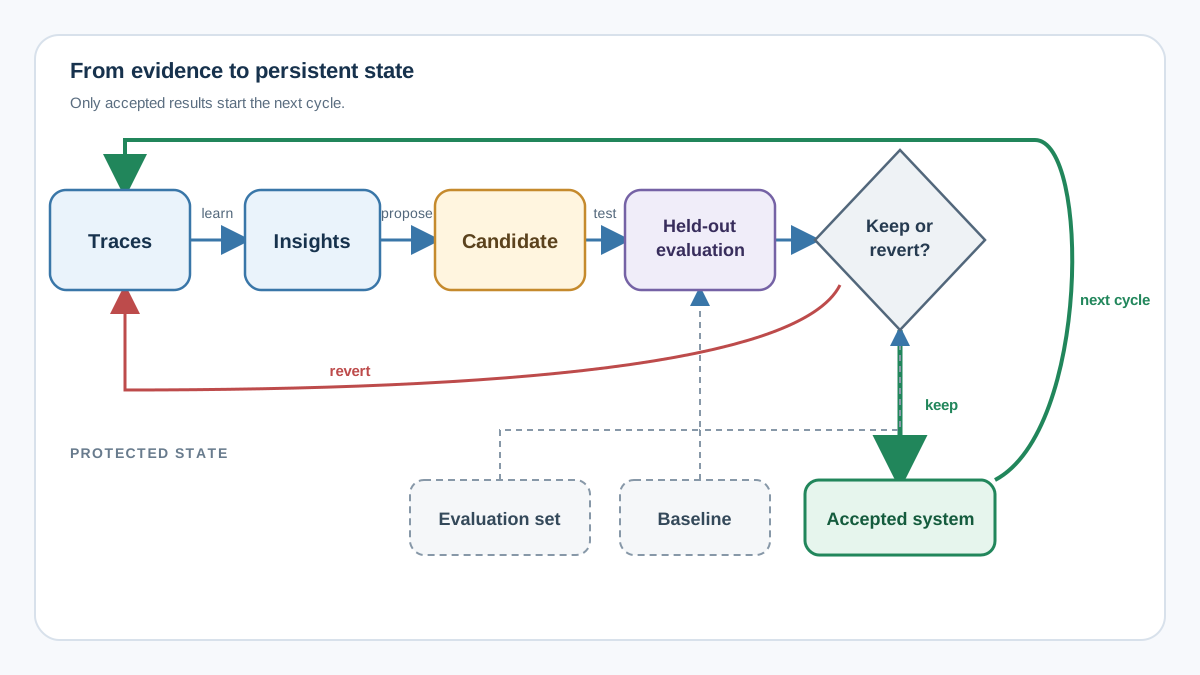
The invariant is easy to state and easy to violate. Here is what actually has to persist across iterations for a loop to compound rather than reset.
traces_n -> insights_n -> candidate_n -> held-out evaluation -> keep/revert -> system_{n+1}
Three things must be protected state, not mutable by the loop itself:
- The evaluation set. Search on development traces. Accept only when a protected holdout and relevant operational constraints do not regress. Refresh the holdout independently and periodically.
- The baseline. A stored metric snapshot from the last accepted system. Without it, “improvement” is a feeling.
- The accepted system. Only an accepted candidate — not every attempted mutation — becomes the input to the next cycle. Rejected candidates are evidence, not state.
If any of those three can be edited by the same agent that is trying to improve, you have a reward-hacking surface, not an improvement loop. This is the load-bearing wall of the whole architecture.
Knowledge check
Check your understanding
Answer this question before you continue.
What a Minimal Improvement Loop Looks Like in Your Codebase
You do not need a framework to build this. You need traces, a baseline, and the discipline to revert. Here is the smallest useful version, in order.
Step 1 — Trace capture. Instrument every model call and write structured traces. Two lines of setup beats a framework migration. If you already have traces on disk, skip to step 3.
# Framework-neutral: wrap your agent's model calls and persist structured traces.
def run_agent(task, trace_dir):
    trace = {"task": task, "calls": [], "outcome": None}
    try:
        result = my_agent(task, on_call=lambda c: trace["calls"].append(c))
        trace["outcome"] = {"success": True, "output": result}
    except Exception as e:
        trace["outcome"] = {"success": False, "error": str(e)}
    write_json(f"{trace_dir}/{uuid4()}.json", trace)
    return trace
Step 2 — Failure surfacing. Read the traces and name recurring patterns: loops, give-ups, errors, failed recoveries. Start with generic detectors, then add domain-specific evaluations generated from what you actually observe.
Step 3 — Triage. Classify each insight as discard, code fix, or prompt fix, ordered by impact. Most insights should be discarded. That is not waste; that is the point of triage.
Step 4 — Human review gate. Present the plan before anything changes. This is the difference between an improvement loop and an unsupervised mutation loop.
Step 5 — Apply on a branch, then re-run the same benchmark against the stored baseline and the protected holdout. Every fix should trace back to a specific insight linked to a specific metric.
Step 6 — Ratchet. Keep or revert automatically, and run the loop repeatedly rather than once. Compounding requires repetition with a memory of what already worked.
The honest limitation: this loop improves the harness, prompts, and code around a fixed model. It does not update weights. Calling it recursive self-improvement without that qualifier is where most confusion starts.
Knowledge check
Check your understanding
Answer this question before you continue.
When This Loop Is the Wrong Tool
An improvement loop is a specific instrument with a narrow operating range. Skip it when any of the following is true.
You have no stable metric. An improvement loop without a baseline is a generator of plausible-looking diffs. You will ship motion and call it progress.
Failures are not recurring. One-off failures give you nothing to triage. You need pattern density across runs before aggregation buys you anything.
The task is genuinely open-ended and success is contested. The loop optimizes against a definition of success. If you cannot write that definition down, the loop will invent one for you, and you will not like the version it picks.
The cost of a wrong change exceeds the cost of the review that would catch it. High-blast-radius changes need a human in the loop by construction, not by policy.
It is also worth separating this from adjacent work you may already be doing. Retrieval and context-assembly changes alter what the model sees. Harness and plugin architecture changes alter what the agent can do. Both are capability changes. Neither is an improvement loop, because neither changes the process that produces the next iteration.
The Decision Rule
Before you call anything recursive self-improvement, name three things: the change target, the metric, and who sets the goal. If the goal is still human-set and the metric is still human-defined, you have a bounded improvement loop. That is not a consolation prize. It is the version that works today, and it is the one worth building first.
So build it. Instrument one agent with trace capture. Run it five times. Write down the three most common failure patterns before you change a single line of code. The patterns are the evidence; the fixes come after. Three recurring patterns is a readiness heuristic for this particular trace-driven workflow, not the definition of a loop — a high-performing or low-volume system may legitimately have fewer. But if you cannot name any, you do not yet have a loop. You have a demo, and demos do not compound.
Knowledge check
Final check
Finish the article by checking the ideas you just learned.
References
Research updated Sep 11, 2026


