
Contextual Prompting vs Context Engineering: Static Background vs Dynamic Context
The prompt tested clean. Then real users arrived, and the answers went stale, contradictory, and ungrounded.

Key topics
The prompt tested clean. Then real users arrived, and the answers went stale, contradictory, and ungrounded.
That is the moment most teams reach for the prompt editor. Sometimes they are right. Often they are treating a context-assembly bug as a wording problem, and every rewrite makes the system harder to repair.
The distinction that resolves this is not prompt versus context as rival techniques. It is a boundary: instructions are stable policy, context is per-decision state. Confuse the two and you lose the ability to tell which layer broke.
The Symptom: A Prompt That Worked Until It Didn't
The failure signatures are consistent enough to recognize:
- Answers drift stale — the model cites a policy that changed last quarter.
- Turns contradict each other — turn four forgets what turn two established.
- The wrong document gets cited — retrieval surfaced something adjacent, not relevant.
- Quality degrades as the conversation grows — the window fills with history and the actual evidence gets crowded out.
The default reflex is to rewrite the prompt. Sometimes that works. If the model understood the task but produced the wrong shape, tone, or refusal behavior, the instruction layer is exactly where the fix belongs. Grant that case fully; it is real and common.
But watch what happens when the failure is a missing fact. You add "always cite the most recent policy version" to the prompt. The model now cites the most recent version of whatever it was given — and it was given an outdated passage. The instruction is correct. The context is wrong. You have added tokens without adding evidence.
The hidden question beneath "should I change my prompt?" is sharper: is the missing thing a rule or a fact? Rules are stable and belong in the instruction layer. Facts vary per decision and belong in the context pipeline. The axis that separates them is stability versus per-decision variability.
Knowledge check
Check your understanding
Answer this question before you continue.
Two Axes, Not One Boundary
The clean version of this comparison — static instructions here, dynamic context there — is useful as a first pass, but it breaks the moment you look at real systems. Instructions can be selected or generated per request. Facts can be frozen into a static reference block. If you treat "static" and "instruction" as synonyms, you will misclassify half the material in a production prompt.
Separate two axes.
Semantic role — what job the text does in the request:
- Policy and instructions. Output contract, refusal rules, citation format, role, tone, safety constraints.
- Task state. What the user is trying to do, what was decided, what remains open.
- Evidence. Retrieved passages, tool outputs, database rows, API payloads.
Delivery behavior — how the text gets into the window:
- Static. Authored once, versioned, shipped identically until someone edits and redeploys.
- Runtime-assembled. Selected, generated, or fetched per request by application code.
Contextual prompting is a prompt-level technique: you supply relevant background, role, audience, or examples inside the prompt. It is often static, but it does not have to be. A template that selects a different policy fragment per user tier is still prompting — the mechanism is prompt construction, not a retrieval pipeline.
Context engineering is the broader discipline: designing, assembling, and managing everything the model sees before inference — including dynamically selected instructions, retrieved evidence, tool results, memory, and the budget that decides what survives truncation.
Here is the boundary test I actually use:
Would this text be identical for the next request? If yes, it is static. If it depends on the request, it is runtime-assembled. Then ask a second question: is this text a rule, a state, or evidence?
The first question tells you how to operate the block. The second tells you who owns it and how to debug it. Collapsing them into one question is what produces the false binary.
Knowledge check
Check your understanding
Answer this question before you continue.
Where Static Background Still Earns Its Place
I have watched teams over-correct into building a retrieval pipeline for information that never changes. That is a mistake in the other direction.
Stable policy belongs in the static instruction layer:
- Output contract — schema, format, required fields.
- Refusal rules — what the system must decline and how.
- Citation requirements — when and how to attribute.
- Role, audience, and tone.
- Safety constraints.
These are cheap, cacheable, reviewable, and diffable. Those are engineering advantages, not nostalgia. A rule that lives in one reviewed place cannot silently diverge across requests.
Two failure modes bracket this section:
Over-static context. Background that should have been retrieved gets frozen into the prompt. The system then answers confidently from an outdated snapshot, and no amount of retrieval fixes it because retrieval never runs.
Under-static context. Rules that should be invariant get re-derived per request. The model improvises the output format each time, and behavior becomes inconsistent across calls in ways that are maddening to debug.
My rule of thumb: if a human reviewer would sign off on this text once and expect it unchanged next month, it is static. If they would want to see it change when the underlying facts change, it is runtime-assembled.
What Dynamic Context Actually Has to Do
Context engineering is not "put more stuff in the prompt." It is a set of operations, each of which is a system component rather than a prompt trick.
Retrieval and selection. Choosing which documents, rows, or passages are relevant to this decision. This is where most grounding failures originate.
Routing. Deciding which model, tool, or sub-agent receives which slice of context. A summarization step and a citation step may need different inputs.
Memory and state. Separating short-term turn state, durable facts, and task progress so they are not blurred into one blob. When these layers collapse, agents hallucinate dependencies and re-ground every request.
Compression and summarization. Replacing long histories with structured summaries that preserve goal, decisions, and open questions. The format matters — a summary that drops the open questions has dropped the state.
Isolation. Keeping untrusted or noisy content from contaminating instruction-layer rules. Retrieved text is data, not policy, and the assembly step should make that structural.
Budgeting. Treating the window as scarce. Every irrelevant passage displaces evidence the model actually needed.
Each of these is a place where the system can fail independently of the prompt. That is why "just rewrite the instructions" cannot fix a retrieval miss.
Knowledge check
Check your understanding
Answer this question before you continue.
A Small Trace: Same Task, Two Designs
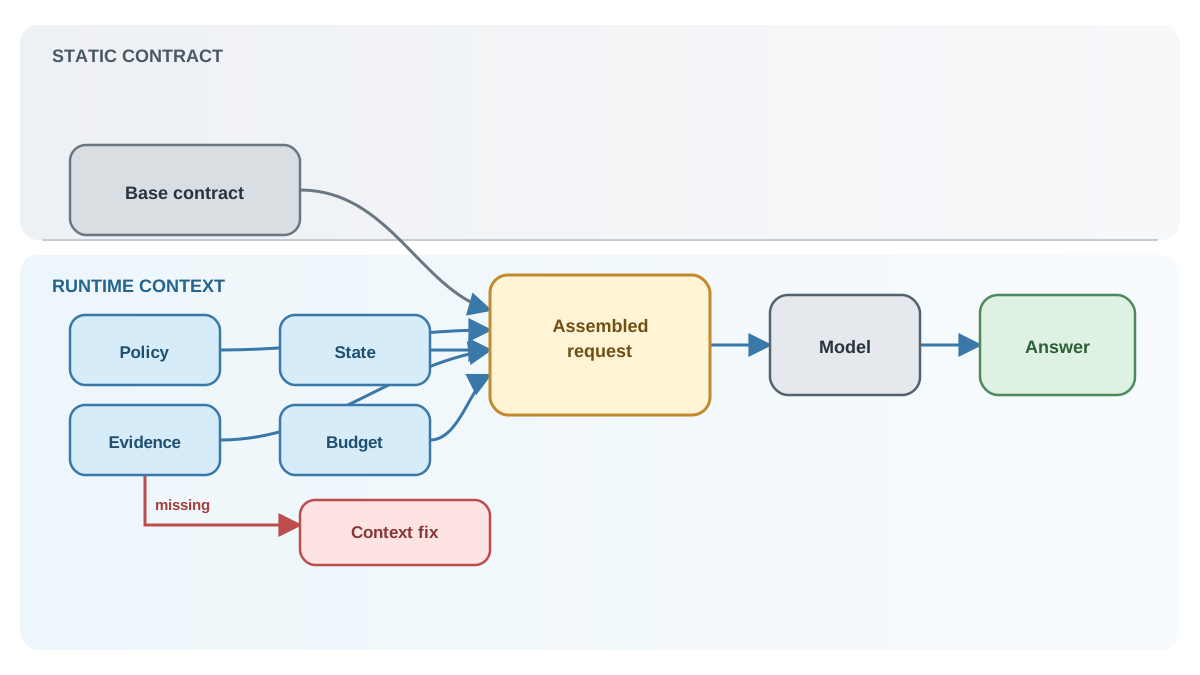
Take a policy Q&A bot with a stable contract and volatile inputs. This is a mixed-runtime request: the base contract is static, but the policy fragment, evidence, and tool result are all assembled per turn.
Static base contract (identical every request):
Answer only from the supplied passages.
If the answer is not in the passages, say "Not in policy."
Cite section IDs in the format [SEC-###].
Return prose, no bullet lists.
Runtime-assembled blocks (selected per request):
[policy_fragment] role=instruction source=hr_policy v=2026-04 reason=user_tier=contractor
  Contractors are covered under section 4.2, not 3.1.

[evidence] role=data source=policy_index v=2026-04-11 reason=retrieval_score=0.81
  SEC-4.2: Contractor eligibility begins after 90 days of continuous engagement.

[evidence] role=data source=policy_index v=2026-04-11 reason=retrieval_score=0.74
  SEC-3.1: Employee eligibility begins after 30 days.

[state] role=state source=session reason=carry_forward
  Turn 1: user asked about parental leave.
  Turn 2: user asked whether it applies to contractors.

[budget] assembled_tokens=1840 budget=2048 dropped=0
At the decision point, the model sees all of it. The base contract tells it how to behave. The policy fragment, evidence, and state tell it what is true right now. The budget line tells you whether anything was silently cut before the model ever saw it.
That last line is the one most teams forget to log. A retrieval miss and a truncation miss look identical in the output but have completely different fixes.
Knowledge check
Check your understanding
Answer this question before you continue.
Debugging by Layer, Not by Vibe
The conceptual boundary becomes useful only when it turns into a habit.
Log the assembled request, not just the template. Record role, source, version, selection reason, and whether the block survived the final budget. The template is the static half; the assembled result is what the model actually saw.
Classify the failure first. Format or behavior failure? Instruction layer. Grounding or freshness failure? Context pipeline. Do this before touching anything.
Evaluate the layers separately. Instruction adherence on one axis — did it follow the contract? Retrieval precision and groundedness on the other — did it have the right evidence? A single blended score hides which layer moved.
The symptom-to-layer mapping is a starting heuristic, not proof:
| Symptom | Likely layer | First thing to inspect |
|---|---|---|
| Wrong format, ignored refusal rule, wrong tone | Instruction | Static contract text, then any runtime-selected policy fragments |
| Missing fact, stale citation, wrong document | Context pipeline | Retrieval scores, freshness metadata, block ordering |
| Contradictory turns | State | Whether turn state was carried forward or dropped |
| Behavior changed after a deploy | Either | Diff the static layer; diff the assembly code |
Symptoms cross layers more often than the table suggests. A wrong citation can come from a bad instruction, poor evidence selection, or a truncation that dropped the right passage. An ignored refusal rule can come from conflicting retrieved text, prompt injection, or assembly order. Before assigning blame, inspect the assembled request: block roles, ordering, truncation outcome, and provenance.
Two mistakes I see repeatedly:
Fixing a retrieval miss by adding more instructions adds tokens without adding evidence. The model cannot cite a passage it was never given.
Fixing an instruction-adherence problem by stuffing more documents in dilutes the rule. The contract competes with noise for attention, and adherence drops.
When do you stop tuning and change the architecture? When repeated failures survive both a prompt rewrite and a retrieval fix. That pattern usually means a missing context operation — no freshness filter, no state separation, no budget control — not a missing sentence.
When Prompt Edits Are the Right Answer
Not every system needs a context pipeline, and building one prematurely adds failure surface before the task has earned it.
Stay in the instruction layer when:
- The task is single-turn, low-stakes, and the inputs are stable.
- The required information is small, fixed, and known at build time. Embedding it is simpler and more debuggable than retrieving it.
- The failure is purely about output shape, tone, or refusal behavior.
Escalate to context engineering when:
- Inputs vary per request.
- Knowledge changes faster than your deploy cycle.
- The window is the binding constraint — history or documents crowd out evidence.
The cost of premature context engineering is real: indexes to maintain, pipelines to monitor, evaluation harnesses to build, and a new class of bugs that did not exist when the answer was simply written down.
The Decision Rule
Before you edit a prompt, ask two questions. Is the missing element a rule, a state, or evidence? Is it stable or per-request?
Rules that are stable go in the static instruction layer. Facts that vary go in the context pipeline. The boundary is not philosophical — it determines who reviews the change, how you log it, and which layer you fix when it breaks.
Instructions are policy. Context is state. Systems that keep them separate stay repairable.
Your next move: pick one production request, log the fully assembled context — static base, runtime-selected policy, evidence, state, and the budget outcome — and classify the last failure you saw as instruction-layer, state-layer, or context-layer. Fix only that layer. If the fix holds, you have found the boundary. If it does not, you were probably fixing the wrong side.
Knowledge check
Final check
Finish the article by checking the ideas you just learned.
References
Research updated Sep 11, 2026


