
Designing a Workspace Operations Agent: Tools, State, Persistence, and Human Approval
The demo works. The agent reads the queue, drafts the update, and posts it. Then someone asks who approved the change, which run produced it, and how to…

Key topics
The demo works. The agent reads the queue, drafts the update, and posts it. Then someone asks who approved the change, which run produced it, and how to undo it — and the room goes quiet.
That silence is the real product boundary. A workspace operations agent is not defined by what it can do. It is defined by what it cannot do without a checkpoint, an identity, and an approval. Everything below builds toward one invariant:
Every side effect is typed, attributed to an identity, checkpointed before commit, and either reversible or gated by approval.
If you already understand harness layers, tool schemas, and checkpoint stores in isolation, this article is about composing them into one bounded workflow that can act on a real workspace without becoming an unreviewable liability.
Why Operations Agents Fail After the Demo
The visible symptom is always the same: the agent succeeds, then leaves no evidence. No attribution, no diff, no rollback path. The work happened, but nobody can prove what changed or reverse it.
The weak mental model is "the hard part is the model and the tools." That model is optimized for capability. It works fine when the agent is answering questions. It collapses the moment the agent mutates shared state.
The stronger model: the bottleneck is the commit boundary between model-directed decisions and irreversible workspace mutations. The model can be excellent and the tools can be well-typed, and the system still fails if nothing separates "the agent decided" from "the workspace changed."
Three failure classes to design against:
- Confident silent failure. The agent reports success, but the write never landed or landed in the wrong place. No artifact exists to contradict it.
- Duplicate side effects after a retry. A step times out, the run retries, and the commit applies twice. Now you have two tickets, two notifications, or two charges.
- Unauthorized scope creep. The agent reaches a tool it was never meant to touch because the tool list was broader than the workflow required.
Scope the build to one bounded workflow: intake → inspect → draft → approve → commit → report. Not a general assistant. A general assistant has no commit boundary you can reason about.
Define the Workflow Before the Agent
Write the workflow as a contract before you write agent code. The contract has eight fields:
| Field | What it pins down |
|---|---|
| Trigger | What starts the run (schedule, event, human request) |
| Inputs | The exact data the run consumes and where it comes from |
| Decision rules | Which steps are deterministic and which require judgment |
| Allowed tools | The closed set of tools the run may call |
| Output artifact | The thing the run must produce to be "done" |
| Approval point | The step that pauses for a human |
| Log location | Where the run timeline is written |
| Rollback path | How a committed change is reversed or compensated |
Most operations workflows are roughly 80% deterministic plumbing and 20% judgment. Name the decision boundary explicitly: which steps may the model choose freely, which must follow a fixed path, and which require a human. If you skip this, the model will infer the boundary for you, and it will infer it wider than you intended.
Define the artifact the run must produce — a report, a ticket, a diff, a change record. "Done" must be observable, not asserted. An agent that says it finished is not evidence. An artifact is.
Anti-pattern: letting the agent's tool list define the workflow. The workflow defines the tool list. If you start from the tools, you will build capability you cannot justify and permission you cannot audit.
When not to build an agent: if the workflow is fully deterministic and the inputs are structured, a scheduled job with validation is cheaper, testable, and debuggable. Delete the agent and keep the job.
Typed Tools and the Commit Boundary
The primary safety mechanism is not a guardrail prompt. It is the classification of every tool into one of three classes.
| Class | Side effect | Example |
|---|---|---|
| Read | None | Fetch a record, list a queue, read a file |
| Propose | Writes a draft artifact only | Create a draft ticket, stage a diff |
| Commit | Mutates shared workspace state | Post the ticket, merge the change, send the notification |
Typed schemas do more than validate input. They constrain the model's action space and make invalid operations unrepresentable rather than merely rejected. A commit tool that requires an explicit target and an idempotency key cannot be called without them.
Idempotency keys on commit tools are what stop a retried step from double-applying a change. The key is derived from the logical operation, not the attempt. But the key only works if the commit store enforces atomicity. Lookup-then-apply is a race condition unless the store guarantees uniqueness:
def commit_update(record_id: str, payload: dict, idempotency_key: str) -> CommitResult:
    # The store must enforce a unique constraint on idempotency_key.
    # A bare lookup-then-apply is a race: two concurrent retries can both
    # pass the lookup before either writes.
    try:
        commit_id = store.apply_atomic(record_id, payload, key=idempotency_key)
        return CommitResult(status="committed", commit_id=commit_id)
    except DuplicateKeyError as e:
        # The first attempt already committed. Return its result.
        return CommitResult(status="already_committed", commit_id=e.existing_id)
The second call returns the first result. The workspace changes once. But that guarantee lives in the store, not in the Python function. If your backing system cannot enforce a unique key atomically, you need a reconciliation read before you can trust the result.
Error signals must be typed too. Distinguish retryable failure, policy denial, and permanent rejection. An agent that treats a policy denial as retryable will loop on a wall until the budget dies.
Descriptions are part of the contract. An ambiguous description is a permission leak, because the model will use the tool in the widest reading it can justify. "Update the record" is a leak. "Set the status field on one ticket to one of the allowed enum values" is a contract.
Smallest useful implementation first: two read tools, one propose tool, one commit tool. Grow from there.
When not to use a commit tool: if the action is irreversible and high-blast-radius, replace it with a propose tool plus an approval gate. The commit happens after a human reads the proposal, not before.
Knowledge check
Check your understanding
Answer this question before you continue.
State, Checkpoints, and Durable Artifacts
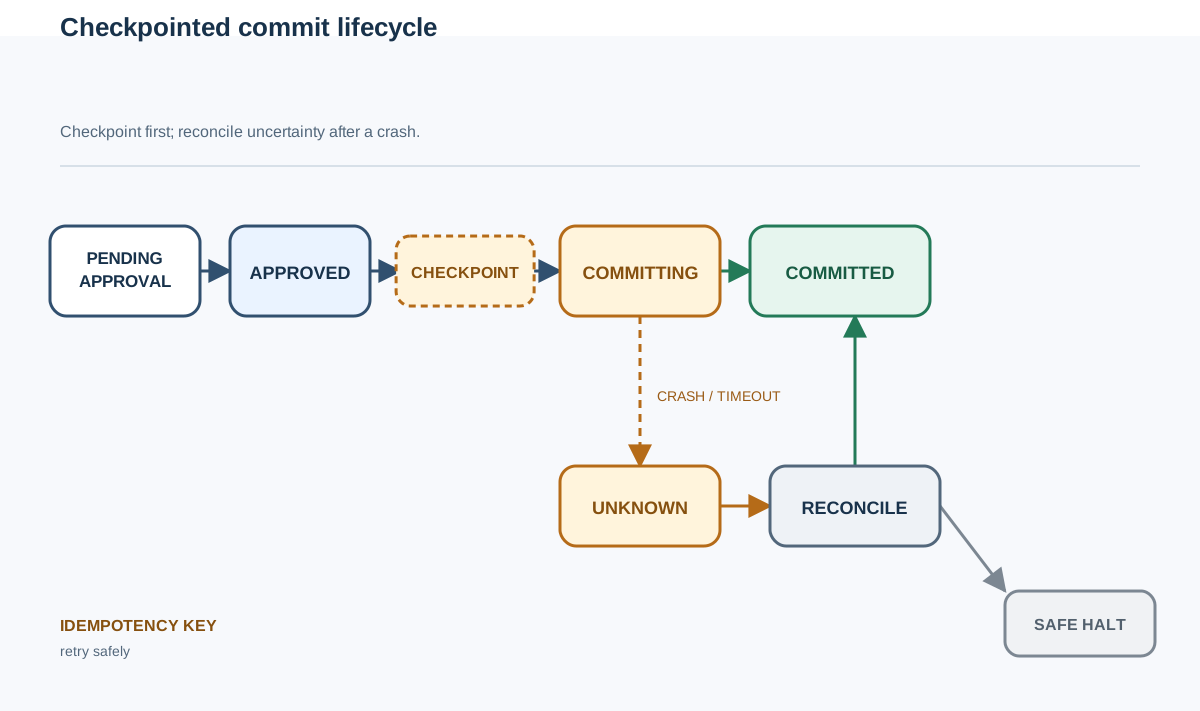
An operations agent carries four kinds of state, and mixing them causes resumption bugs.
| State kind | Lives where | Purpose |
|---|---|---|
| Working state | In-run scratch | Intermediate values for the current step |
| Durable checkpoints | Checkpoint store | Resumable run position and intent |
| External stores | Systems of record | The real workspace data |
| Artifacts | Artifact store | The run's output and audit surface |
Checkpoint before commit, not after. The checkpoint must describe the intent so a resumed run can detect whether the commit already happened. If you checkpoint after the commit, a crash between the two leaves a committed change with no record that it was attempted.
But a pre-commit checkpoint alone does not tell the resumed process whether the external write landed. The process can crash after the side effect but before the result is recorded. That window is where exactly-once execution either holds or falls apart. Model it explicitly:
PENDING_APPROVAL → APPROVED → COMMITTING → COMMITTED
                                    ↓
                                 UNKNOWN
The crash window sits between the external write and the local record of its result. If the process dies there, the run resumes in UNKNOWN. The idempotency key lets you retry safely — but only if the destination store supports an atomic idempotency record. If it does not, you need a reconciliation read: query the destination for the operation's effect before deciding whether to retry.
The idempotency key is not a universal fix. It is a contract with the backing store. If the store cannot enforce uniqueness atomically, the key degrades to a best-effort hint, and
UNKNOWNrequires a reconciliation path.
Artifacts are the audit surface. A run that produced no artifact produced no evidence. The artifact is what lets a human answer "what changed" without reading the transcript.
Keep conversation context separate from operational state. A long chat is not a source of truth. Threads carry dialogue; the checkpoint store carries position. When the transcript is truncated or compressed, the run must not lose its place.
What must never live in agent memory: credentials, tokens, and raw secrets. Reference them by handle and resolve them at the execution boundary. The workspace can hold operating knowledge, project notes, and logs. It should not hold the keys.
Failure mode: storing the plan in the prompt and the state in the transcript. When the transcript is compressed, the run loses its position and either stalls or re-executes work it already did.
The resumption test is the one that matters: kill the process mid-run, restart, and verify the agent either completes the pending step or correctly reports it as already committed. Run this test before you trust the workflow.
Knowledge check
Check your understanding
Answer this question before you continue.
Permissions, Identity, and Least Authority
Give the agent a first-class identity rather than running it as an anonymous session. Its actions must be distinguishable from human actions in logs. A dedicated identity also decouples the agent from the lifecycle of the account that created it.
Delegated authorization inherits the creator's access. A dedicated identity with an explicit scope list is narrower and easier to reason about. Both patterns exist in real platforms, and the tradeoff is real: delegation is simpler to set up, dedicated scope is simpler to audit.
Scope tools to the smallest workspace surface that completes the workflow — one folder, one queue, one table, not the whole tenant. Separate read scope from write scope. Most operations agents need broad read and narrow write.
Authorization failures should be a distinct, non-retryable signal that surfaces to the operator, not a silent skip. A silent skip looks like success and hides a boundary the agent hit.
Open question: identity and delegation semantics differ across platforms and change between versions. Verify against your runtime rather than assuming a universal model.
Approval Checkpoints That Actually Resume
Model approval as a durable pause. Persist the pending action, its parameters, and its idempotency key, then exit the run. Do not hold the run open waiting for a human.
Resume by re-reading the approval record from the external system, not by trusting in-memory state or the model's recollection. The external record is the source of truth for the decision.
But approval authorizes a specific operation, not an unrestricted later action. Before committing on resume, revalidate three things: the identity still has permission, the policy still allows the action, and the target has not changed since the proposal was created. A durable approval can outlive a permission change or a target mutation. If the target version differs from what the reviewer saw, the approval is stale and the run must re-propose.
The duplicate trap is the one that bites. If the run resumes and re-executes the commit because it cannot tell whether the first attempt landed, you get double side effects. The idempotency key is the fix — provided the store enforces it atomically, as covered above. The resumed run calls the same commit with the same key and gets the first result back.
Approval payloads must be specific enough to review:
{
  "action": "commit_update",
  "target": "queue/ticket-4821",
  "target_version": "v3",
  "parameters": { "status": "resolved", "note": "..." },
  "idempotency_key": "run-7f3a:step-4",
  "rollback": "reopen ticket-4821 and restore prior status",
  "blast_radius": "single ticket"
}
A reviewer needs to see what will change, in which system, with what parameters, and what the rollback is. A payload that says "approve update" is not reviewable.
Rejection is a first-class outcome. The agent should record it, notify, and stop cleanly rather than retrying or rephrasing the request. Define escalation rules: which conditions force a pause (high blast radius, ambiguous input, missing data) versus which proceed automatically.
When not to gate: gating every low-risk read or draft step trains operators to rubber-stamp, which destroys the value of the checkpoint. Gate the commits that matter.
Knowledge check
Check your understanding
Answer this question before you continue.
Observability, Evaluation, and Recovery
Log the run as a timeline: trigger, tool calls with arguments, decisions, checkpoint writes, approval events, commits, and terminal state. Record provenance for every artifact — which run, which model version, which tool versions, which inputs.
Evaluation set: replay a fixed set of past workspace tasks and score four things.
| Metric | What it catches |
|---|---|
| Outcome correctness | Did the run produce the right artifact? |
| Unnecessary tool calls | Is the agent wandering? |
| Approval precision | Did it pause on the right steps? |
| Duplicate-commit rate | Did retries double-apply? |
Track the metrics that predict operational pain: approval rejection rate, retry rate, resume success rate, and mean time to isolate a failure. These are the numbers that tell you whether the boundary is holding.
Recovery paths, by failure class:
- Retryable failure → bounded retry with backoff.
- Committed side effect → compensate or roll back.
- Unknown state → halt, reconcile against the destination, then escalate.
Failure mode to design for: the agent fails confidently and leaves no evidence. The log and the artifact are the antidote. If you cannot reconstruct what happened from the log, the run is not observable.
One honest baseline: on complex multi-file workspace tasks, human operators still outperform fully autonomous agents. Treat human-in-the-loop as a durable component of the architecture, not a temporary crutch you remove once the model improves.
Knowledge check
Check your understanding
Answer this question before you continue.
Build Order and Decision Rules
Build in this order: workflow contract → read tools → propose tool → artifact writer → checkpoint store → approval gate → commit tool → observability.
The smallest useful drill before the full build: implement one propose-then-approve-then-commit cycle end to end, then kill the process between approval and commit. Prove resumption works before you add a second commit tool.
Decision rules:
- Adding a tool: add it only when the workflow contract names the step and the tool class (read/propose/commit) is unambiguous.
- Adding autonomy: expand model-directed scope only after the evaluation set shows approval precision and duplicate-commit rate are acceptable.
- Stopping: if the workflow is deterministic and inputs are structured, delete the agent and keep the job.
The invariant is the design. A workspace operations agent is defined by what it cannot do without a checkpoint, an identity, and an approval — not by what it can do.
Carry one rule forward: expand autonomy only after the evaluation set proves approval precision and duplicate-commit rate. Then run the kill-and-resume test on your own workflow, and add one adversarial input to the evaluation set. Watch how the agent fails. That failure is the next design decision.
Knowledge check
Final check
Finish the article by checking the ideas you just learned.
References
- Create and Configure Operations Agents - Microsoft Fabric | Microsoft Learn
- Multi-agent Workflow with Human Approval using Agent Framework | Microsoft Community Hub
- GitHub - dimileeh/agent-workspace-fabric: Control plane that runs AI coding agents (Codex, Claude Code, Gemini, OpenCode, Grok, Cursor) as disciplined contributors: each task gets an isolated git worktree + Docker Compose stack, profile-driven validation, a created PR, and an autonomous PR-monitor loop (review, CI fixes, base sync, auto-merge). GitHub & BitBucket. Apache-2.0. · GitHub
- Workspace-Bench 1.0: Benchmarking AI Agents on Workspace Taskswith Large-Scale File Dependencies
- Workspace agents - Resource | OpenAI Academy
Research updated Sep 11, 2026


