
Is RAG Dead? What Actually Died—and What Replaced Naive RAG
The demo worked. Then the corpus grew, the questions started requiring synthesis across documents, and the same pipeline that felt magical last month now…

Key topics
The demo worked. Then the corpus grew, the questions started requiring synthesis across documents, and the same pipeline that felt magical last month now returns confident answers built on the wrong three chunks. That is the moment most engineers go looking for a headline: is RAG dead? Retrieval did not die. Unguarded retrieval did. What replaced it is not a single successor technology—it is verified context assembly: a system that chooses how to acquire context by query shape and data change rate, then enforces evidence contracts at every boundary.
What Actually Died: The Naive Pipeline, Not Retrieval
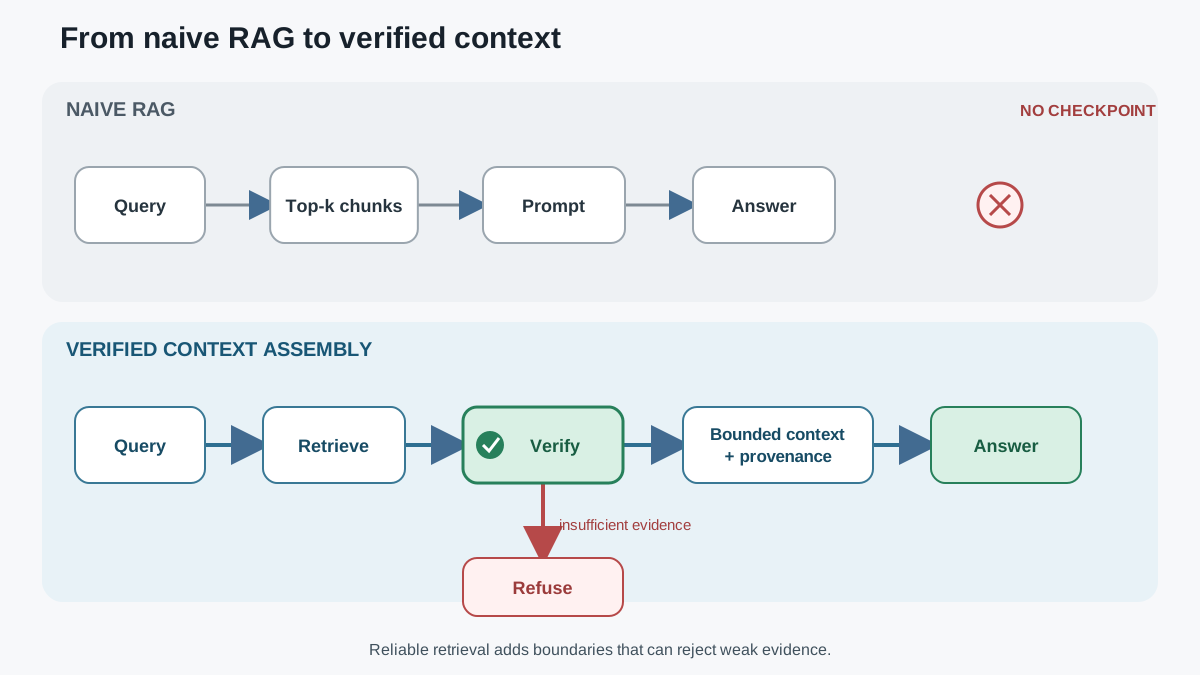
Naive RAG is a linear contract. Offline, you index documents. Online, you embed the query, pull the top-k nearest chunks, stitch them into a prompt, and generate. There is no verification between stages. Each stage assumes the previous one succeeded.
That assumption is the failure. When a pipeline like this feels clunky, the problem is almost never the vector database or the model in isolation. It is the boundaries between them:
- Retrieval returns something, not the right thing. Cosine similarity is a ranking signal, not a correctness proof.
- Chunking optimizes for embeddings, not semantics. Fixed-size windows split arguments mid-thought and duplicate meaning across neighbors.
- Prompt stitching assumes relevance instead of proving it. The model receives whatever survived top-k and is expected to sort signal from noise on its own.
- The model is forced to sound confident on weak context. Fluency is the default output; grounding is not.
Notice what these have in common. Every one is a missing guarantee, not a missing component. The pipeline has no stage that can signal insufficiency.
This is why the "RAG is dead" claim keeps collapsing into confusion. It conflates a concept with an implementation. The concept—grounding generation in external evidence—is not going anywhere. The implementation—vector search plus blind stuffing—was never a guarantee of anything. It was a fast way to get a demo running.
The invariant that matters: every stage must have an explicit failure or insufficiency state, and every answer must be traceable to verified evidence. Only answer-producing stages need to refuse in natural language; indexing and retrieval stages need to fail loudly in their own terms. If your pipeline cannot fail loudly, it will fail quietly.
Knowledge check
Check your understanding
Answer this question before you continue.
The Real Decision Axis: Ingest-Time vs Query-Time Compression
Before comparing retrieval, memory, long context, and agents feature by feature, collapse them onto one axis: when does your system spend compute to compress raw documents into usable knowledge?
Ingest-time compression happens when the document arrives. You summarize, extract structure, build an index, or write a knowledge base. The payoff is cheap, fast, consistent queries. The cost is staleness and lossy summarization—whatever you threw away at ingest time is gone by query time.
Query-time compression happens when the question is asked. Retrieval, agentic search, and long-context stuffing all live here. The payoff is freshness and question-specific focus. The cost is latency, token spend, and non-determinism.
This axis dissolves most of the "RAG alternatives" confusion. A long-context window is a query-time strategy. An agentic search loop is a query-time strategy. A pre-built knowledge graph is an ingest-time strategy. Almost every so-called replacement is one of these two moves wearing a new name—and most query-time strategies still depend on an index underneath.
The axis stops being exact at the hybrid boundary. Real systems do both: they pre-compute structure at ingest time and retrieve against it at query time. The interesting engineering question is not "which one" but which layer owns which guarantee. If your ingest layer guarantees freshness, your query layer can be simpler. If your query layer guarantees verification, your ingest layer can be lossier.
That gives you the governing model for everything below. Choose your context-acquisition strategy by query shape and data change rate, then enforce evidence contracts at each boundary. The rest of this article applies that two-part rule to long context, retrieval, agentic loops, and evaluation.
Knowledge check
Check your understanding
Answer this question before you continue.
Long Context Did Not Replace Retrieval—It Moved the Bottleneck
Grant the narrow case first. For a small, stable, single-document task, stuffing the whole thing into the window is simpler and often better than building a pipeline. If your entire corpus fits and never changes, retrieval is overhead.
Then watch what breaks as scale increases. Attention over a crowded window is not the same as selection. Irrelevant tokens compete for the model's effective focus, and grounding can degrade even when the answer is present in the context. A larger window is a bigger desk, not a persistent store. Nothing accumulates between requests unless you build the accumulation.
The operational reason retrieval survives is arithmetic. Under stuffing, per-query token spend scales with corpus size. Under a bounded retrieval path—fixed top-k, no reranking cascade, no multi-hop expansion—per-query spend stays roughly flat. That difference compounds across every request, and it is why production systems keep an index even when the model accepts a million tokens. The claim is conditional: add reranking, multi-hop calls, or expanding context and the flat line bends.
The decision boundary is plain: long context wins below a corpus-size and query-complexity threshold; retrieval wins above it. Most real systems sit in the middle, and the only honest way to place yours is to measure it.
Knowledge check
Check your understanding
Answer this question before you continue.
Retrieval as a Contract: Verification, Refusal, and Bounded Context
Stop treating retrieval as a feature you bolt on. Treat it as a contract with preconditions and postconditions. What must be true before the model is allowed to generate?
A contract model forces concrete mechanisms:
Reranking as a gate, not a nicety. The difference between "similar" and "verified" is a second scoring pass that can reject. If nothing in your pipeline can drop a chunk, you have ranking, not verification.
Refusal-first behavior. The system must be allowed to say the evidence is insufficient. That requires an explicit insufficiency state—not a low-confidence generation that the model papers over with fluent prose.
Bounded context assembly. Budget tokens deliberately. Order evidence by relevance and recency. Keep provenance attached so a wrong answer traces back to a wrong chunk instead of vanishing into one generation call.
Separated explanation and answer phases. When the model first states what evidence it found and why it is relevant, the retrieval decision becomes observable. Debugging stops being archaeology.
The failure path to plan for is index drift. Stale embeddings produce retrieval that is technically correct against an index that no longer matches the source of truth. The system answers confidently from a document that was deleted six months ago. No amount of prompt engineering fixes a lie in the index.
The Silent Failure of Lossy Ingest
The ingest-time/query-time axis has a specific failure mode that deserves its own example, because it is the one that makes the replacement frame concrete.
Suppose your ingest pipeline summarizes each policy document into a structured record: effective date, jurisdiction, base rule. A user asks about an exception that only appears in a footnote of the original. The summary discarded it. Retrieval now returns the correct record, the model generates a fluent answer, and the answer is wrong—not because retrieval failed, but because the representation it retrieved from was already lossy.
The fix is not "summarize better." It is to keep source provenance and allow fallback to source-level retrieval when the precomputed representation cannot answer. That is the decision boundary between precomputed knowledge and source retrieval: precompute when the query distribution is predictable and the cost of a miss is low; keep the source path open when a discarded detail could change the answer.
Knowledge check
Check your understanding
Answer this question before you continue.
Agentic Retrieval: When the Model Owns the Query Loop
Passive pre-retrieval fetches everything before generation: one query, one shot, all chunks in hand. Interleaved retrieval-and-reasoning lets the model issue follow-up queries based on intermediate results.
Multi-hop questions expose why the fixed pipeline cannot compete here. The second query depends on what the first query returned. A pipeline that fetches once cannot express that dependency.
Here is what that dependency looks like as a state trace for a single multi-hop query:
state: { question: "Which subsidiary of Acme was fined in 2024, and for what?" }
step 1  query: "Acme subsidiaries"
        retrieved: [subsidiary list doc]
        extracted: unresolved entity = "Acme Logistics"
step 2  query: "Acme Logistics 2024 fine"
        retrieved: [regulatory filing, news summary]
        extracted: unresolved constraint = "fine amount and statute"
step 3  query: "Acme Logistics 2024 fine statute"
        retrieved: [filing section 4.2]
        sufficiency check: evidence covers entity, year, statute, amount -> PASS
answer:  grounded response citing filing section 4.2
The loop only works because it has explicit stopping and refusal conditions. Without a sufficiency check, the agent keeps querying or stops arbitrarily. Without a refusal state, it answers from partial evidence. The trace above is the mechanism; "agentic retrieval" is just the label.
The cost is real. More model calls, higher latency variance, harder-to-reproduce traces, and a new failure mode: the agent loops or converges on a dead-end reasoning path. Research on policy-correction and exploration methods for RL-trained retrieval agents addresses the dead-end problem directly—but those are training-time interventions, not drop-in production patterns. Treat them as evidence that the loop is genuinely hard, not as a recipe you can copy.
My decision rule: adopt agentic retrieval when queries are genuinely multi-hop or the corpus is heterogeneous. Keep the fixed pipeline when queries are single-fact lookups and latency budgets are tight. Do not build a reasoning loop for a lookup table.
What to Measure Before You Rewrite Anything
Turn the architecture debate into a controlled comparison you can run this week. Hold the question set and the source snapshot constant. Run three candidate strategies against the same inputs: long-context stuffing, fixed retrieval with reranking, and agentic retrieval. Record the same metrics for each.
| Metric | What it tells you | If it fails, change |
|---|---|---|
| Evidence recall (correct passage in retrieved set) | Whether the index and query formulation can find the answer at all | Chunking, embedding model, query rewriting |
| Final-context inclusion (correct passage survived reranking) | Whether the gate is dropping good evidence | Reranker threshold, context budget |
| Unsupported-answer rate (answered without evidence) | Whether the model is papering over weak context | Refusal logic, grounding prompt, generation model |
| Refusal precision (false refusals vs false confidence) | Whether the insufficiency state is calibrated | Threshold tuning, evidence sufficiency check |
| Latency (p50 and p95) | Whether the strategy fits the interaction budget | Strategy choice, caching, parallel retrieval |
| Token cost per query | Whether the strategy scales with corpus growth | Compression timing, context budget |
The diagnostic interpretation matters more than the numbers. If evidence recall is low, no prompt change will save you—the answer was never in the context. If evidence recall is high but final-context inclusion is low, your reranker is the bottleneck. If both are high but unsupported-answer rate is high, the problem is generation, not retrieval. Architecture changes follow the failed contract, not aggregate answer accuracy alone.
Small, narrow-domain test sets beat large generic benchmarks for this decision. You are testing your corpus and your query distribution, not a leaderboard.
A benchmark score is a result under agreed test conditions. Reliability is what remains when ordinary inputs, missing data, and stale indexes disturb those conditions.
Choosing Your Architecture: A Decision Table
| Situation | Default | Why | Primary cost | Failure to watch |
|---|---|---|---|---|
| Small, stable corpus; single-fact queries | Long context or keyword index | Simpler than a pipeline; no index to maintain | Token spend if corpus grows | Silent degradation as corpus outgrows the window |
| Large or fast-changing corpus; single-fact queries | Retrieval with reranking gate | Flat per-query cost; freshness via reindex | Index maintenance and drift | Stale embeddings answering from deleted sources |
| Multi-hop or synthesis-heavy queries | Agentic retrieval loop | Second query depends on first result | Latency variance, trace complexity | Dead-end loops, non-reproducible answers |
| Heterogeneous sources with structured metadata | Hybrid keyword + vector over structured index | Structure outperforms raw chunking on enterprise content | Upfront schema work | Over-engineering when a keyword index would do |
Two boundaries deserve explicit warning. Do not build an agentic loop for a lookup table—the control flow costs more than it returns. Do not stuff a 500k-token corpus into a window because the model accepts it; acceptance is not selection.
And notice the overkill boundary: a keyword or hybrid index over well-structured documents often outperforms a vector pipeline on structured enterprise content. When retrieval is fast, structured, and directly callable, the distinction between RAG and agents dissolves. The model submits queries and gets back relevant results. Nobody needs to argue about the label.
One open question remains honest: how much of the ingest-time versus query-time split should be automated is still an active design debate. The answer depends on how fast your source of truth changes. If it changes hourly, push compression to query time. If it changes quarterly, precompute aggressively.
The Next Move
Retrieval did not die. The unverified pipeline did. The question was never "RAG or not RAG." It is where knowledge gets compressed, what guarantees each stage owes the next, and whether the system is allowed to refuse.
Before you change any architecture, instrument the boundaries of your current pipeline: query, retrieved set, reranked set, assembled context, final answer—one trace, five stages. Then run the controlled comparison above on a small narrow-domain test set. Find the stage that cannot fail loudly. That stage is where your rewrite starts, and it is probably not the one the headline told you to replace.
Knowledge check
Final check
Finish the article by checking the ideas you just learned.
References
Research updated Sep 11, 2026


