
What Is an AI-Native Startup? Lessons from Anthropic’s Founder’s Playbook
Two seed-stage teams ship an LLM-backed product. Same headcount, same model access, same demo polish. Eighteen months later, one compounds while the other…

Key topics
Two seed-stage teams ship an LLM-backed product. Same headcount, same model access, same demo polish. Eighteen months later, one compounds while the other drowns in generated code nobody can explain, debug, or safely delete. The difference is not how heavily each team uses AI. It is where the AI sits in the architecture and who owns its failure modes.
That distinction is what "AI-native" should mean. Not a deck adjective. A structural claim you can test, falsify, and staff against.
The Remove-the-AI Test Is One Axis, Not the Whole Verdict
Here is the diagnostic I reach for first: delete the model and its surrounding inference path. Does the product still deliver its core value, or does it stop existing?
Run it by tracing which user-visible outputs depend on a model call. If you can stub the model with a lookup table and the product survives, AI is a feature. If the product's decisions collapse without inference, AI is the substrate.
Three positions sit on this spectrum:
| Position | What the model does | Architectural? |
|---|---|---|
| AI as feature | Summarizes, drafts, suggests inside a deterministic flow | No |
| AI as internal accelerator | Speeds up research, codegen, ops for the team | No |
| AI as decision layer | Chooses what happens next in the product's core path | Yes |
Only the third is architectural in the product. The first two are real leverage, but they describe how a company works, not what the product is.
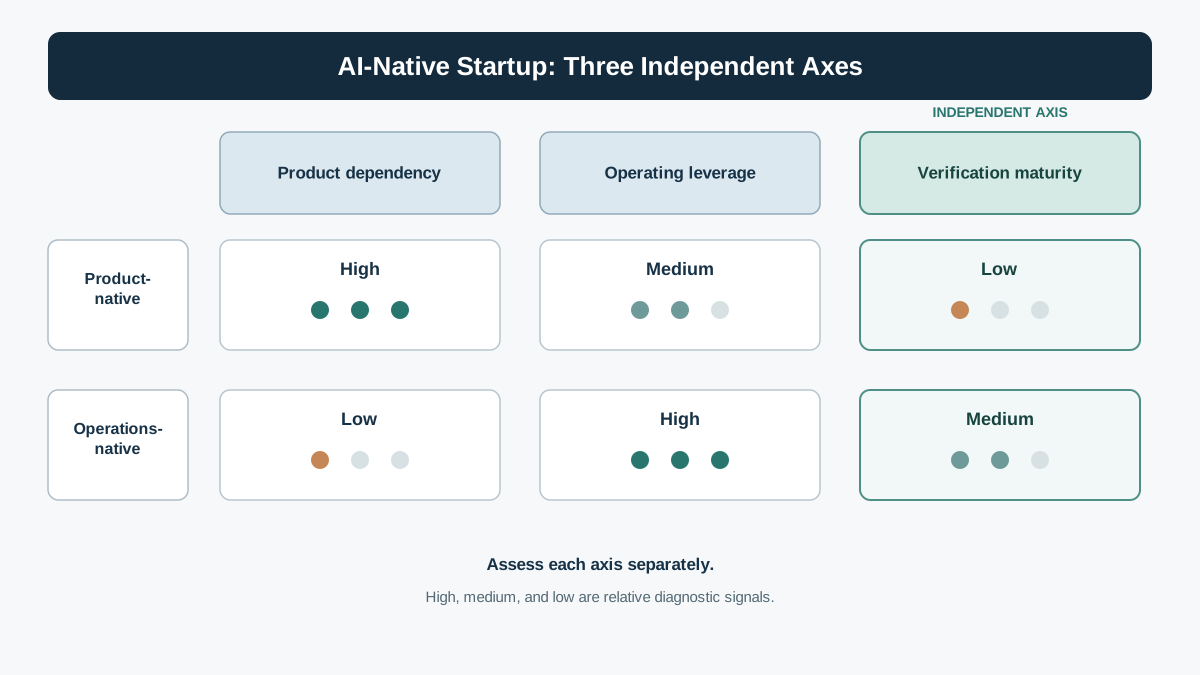
This is where most treatments of the term go wrong. They collapse three separate questions into one label:
- Product dependency — is AI load-bearing in the customer-facing core path?
- Operating leverage — is AI embedded in how the company runs (research, codegen, support, ops)?
- Verification maturity — does the company have evaluation harnesses, failure-rate measurement, and named owners for AI behavior?
A company can be AI-native in operations while selling a deterministic product. A company can have an AI-dependent product while still lacking AI-native operating discipline. The remove-the-AI test answers question one. It does not answer two or three, and treating it as the whole verdict is the most common classification error I see.
The test also gets murky in hybrid systems, and that is where most serious products live. Agents handle dynamic, goal-driven operations that require adaptation. Deterministic workflows handle repeatable tasks in regulated or auditable paths. That hybrid is not a compromise; it is the honest architecture. The failure mode is claiming the agentic half while shipping the deterministic half and calling the gap "roadmap."
The deeper failure: teams that pass the product-dependency test on paper but have no evaluation harness. If the AI is the product, and the product is unmeasured, you have built a demo with a billing page.
Knowledge check
Check your understanding
Answer this question before you continue.
From Product Diagnostic to Company Design
Once you know where AI is load-bearing, the operating questions follow. That is the bridge most AI-native discussions skip: architectural centrality does not by itself dictate org design. It dictates what must be measured and owned, and that in turn shapes workflows, hiring, and stage gates.
So carry the three axes forward. For each AI-dependent workflow — product or internal — you should be able to name the human decision it changes, the observable failure signal, and the accountable owner. If you cannot fill in all three, you have leverage you cannot yet defend.
Founder as Orchestrator: What Actually Changes
The Anthropic founder playbook frames the founder role as shifting from individual contributor to orchestrator of agents that read files, run commands, execute code, and browse the web. That framing is easy to repeat and easy to misread as motivation. Read it as a change in where attention and review capacity go.
What it buys: parallel workstreams that previously required headcount, and a shorter path from idea to running artifact. A single founder can now run market research, draft competitive landscapes, and ship a working prototype in the time it used to take to schedule the first engineering interview.
What it costs: the founder becomes the bottleneck for review, judgment, and error triage. Throughput rises. Verification capacity does not. This is the same asymmetry that shows up in any pipeline where generation is cheap and validation is expensive — and it is the asymmetry that quietly kills AI-native teams.
The non-obvious consequence is who can found. When the founding pool expands beyond people with engineering backgrounds, domain experts can ship production applications without writing code. That changes what the first hire should be. If the founder is a domain expert orchestrating agents, the first hire is often not another generalist — it is someone who can audit what the agents produce.
If the founder cannot read the generated artifact well enough to reject it, orchestration is delegation without accountability.
That is the decision rule. Orchestration is a real capability only when the orchestrator can say no to the output.
Knowledge check
Check your understanding
Answer this question before you continue.
Stage Gates: Idea, MVP, Launch, Scale
The playbook remaps the four classic startup stages — Idea, MVP, Launch, Scale — with goals, exit criteria, and failure modes for each. The useful move is not to summarize it but to treat each stage's exit criterion as a gate that AI capability cannot substitute for.
Idea stage. AI compresses problem validation and competitive mapping. The exit criterion is still evidence from real users, not synthesized confidence. A model that produces a polished market analysis has not validated demand; it has produced a document.
MVP stage. Two goals run in parallel: ship the smallest real solution, and avoid compounding technical debt in a codebase largely written by models. The second goal is the one teams skip. Fast generation feels like progress until the codebase outpaces the team's shared mental model of it.
Launch stage. The operating system shifts from founder attention to agentic workflows. The operational risk is silent failure. An unattended workflow that stops working does not page anyone; it just stops producing, and you find out from a customer.
Scale stage. Moats come from accumulated depth — domain expertise encoded in the product, integration depth with the tools users already rely on, and proprietary workflow data. Not from model access. Model access is a commodity; the depth you build on top of it is not.
The failure mode across all four stages is the same: treating a stage's AI capability as a substitute for its exit criterion. AI makes the work faster. It does not make the gate optional.
Knowledge check
Check your understanding
Answer this question before you continue.
Where AI-Native Codebases Rot
The mechanism is specific. High-volume code generation outpaces the team's shared mental model of the system. Ownership becomes ambiguous. Nobody remembers writing the module, so nobody feels responsible for its failure modes.
The countermeasure is architecture and scope discipline: constrain what the model is allowed to generate before it generates it. That means explicit module boundaries, defined interfaces, and a rule about what the model may not touch. Generation without constraint is not speed; it is debt with a shorter invoice cycle.
Security posture matters more here, not less. AI-generated MVP code tends to carry a wide dependency surface, inconsistent secrets handling, and a review path that assumes someone remembers the original intent. If nobody does, the review is theater.
Observability is the debt detector. If you cannot trace a production failure back to the prompt, tool call, or code path that produced it, you have already lost the thread. The question is not whether the system works. It is whether you can explain why it failed.
For regulated or auditable paths, keep deterministic workflows. Reserve agents for dynamic, goal-driven operations where adaptation is the point.
That boundary is not a limitation on ambition. It is the line between a system you can defend to a regulator and a system you can only defend in a demo.
Knowledge check
Check your understanding
Answer this question before you continue.
Measuring Fit Without Fooling Yourself
AI-native teams are especially vulnerable to false fit signals. Fast demos, fast prototypes, and fast content make weak demand look like traction. A polished prototype is not evidence. It is a hypothesis wearing a nice coat.
Define the observable narrowly: retention and repeat usage on the core AI-dependent path. Not signups. Not demo requests. Not waitlist size. The path that only works because the model works.
Evaluation belongs to the product function, not the research function. The same harness that grades model behavior should grade whether the product's core promise holds. If your eval suite measures model accuracy but not whether the product delivers its value, you are measuring the wrong layer.
When reading any AI-native playbook — including the one this article draws on — separate confirmed facts, vendor claims, and inference. The playbook is a primary source for how Anthropic frames the problem. It is not independent evidence that the framing produces outcomes. That distinction matters when you are deciding what to copy.
If you cannot state the failure rate of your core AI path, you do not yet have a fit measurement.
Everything else is enthusiasm with a dashboard.
Ownership, Roles, and the First Hires
Ownership is where branding collapses into reality. Every AI-dependent capability needs one human who can explain why it fails, not just that it works.
The role shift is real: junior roles become AI-managing roles, which makes task specification and feedback skill the entry-level competence. People who have managed people often adapt well here, because assigning tasks clearly and giving feedback is the same skill applied to a different worker.
Three roles carry a product from prototype to paying customer:
- A product leader who judges whether AI behavior maps to customer value and sets the right constraints.
- A validation engineer who audits architecture, evaluation harnesses, and failure modes in production.
- A relationship builder who handles procurement, trust, and the buyer's risk calculus.
Over-hiring is the default mistake. AI absorbs execution volume, so headcount added for capacity rather than judgment becomes drag. The criterion that separates leverage from fragility is verification capacity: how many AI-dependent paths can your current team actually review, measure, and own? If that number is smaller than the number of paths you ship, adding people to produce more is the wrong move.
Governance from day one at seed scale does not mean a full framework. It means a named owner for model behavior, data handling, and user-facing failure. Most full governance frameworks assume roles a seed-stage company does not have. Skipping governance entirely creates diligence problems later. The middle path is one named owner and a written rule for what happens when the model is wrong.
The Next Move
Before you label the company, fill in the scorecard. For each AI-dependent workflow — product or internal — write down four things:
| Axis | AI-dependent workflow | Human decision it changes | Observable failure signal | Accountable owner |
|---|---|---|---|---|
| Product dependency | ||||
| Operating leverage | ||||
| Verification maturity |
Two contrasting reads make the point concrete. A product-native company sells an agent that routes support tickets; its core path collapses without inference, so product dependency is high — but if nobody tracks misroute rate, verification maturity is low, and the label is premature. An operations-native company sells deterministic logistics software but runs its research, codegen, and support on agents; product dependency is low, operating leverage is high, and the same verification question applies to every internal workflow.
Pick the one AI-dependent path your product cannot survive without. Write down its failure rate. Name the human who owns it.
If either is missing, the company is AI-flavored, not AI-native — and that gap is the next thing to fix, not the next thing to brand. Start with the failure rate. It is the cheapest measurement you can take, and the one most likely to change what you build next.
Knowledge check
Final check
Finish the article by checking the ideas you just learned.
References
Research updated Sep 11, 2026


