
Prompt Engineering as Interface Design: From Vague Requests to Explicit Behavior
The prompt worked on your laptop. In production, the same prompt returns a paragraph on Monday, a bulleted list on Tuesday, and a confident fabrication on…

Key topics
The prompt worked on your laptop. In production, the same prompt returns a paragraph on Monday, a bulleted list on Tuesday, and a confident fabrication on Wednesday. Nothing in the prompt changed. The input distribution did.
That gap is where most prompt work quietly fails. A prompt that produces a good answer once is an experiment. A prompt that produces a predictable answer under ordinary input variation is an interface. The difference is not cleverness or wording. It is whether you specified the contract.
I have watched this pattern repeat across enough systems to trust it: the engineers who ship reliable model behavior are not the ones writing the most elaborate prompts. They are the ones who treat a prompt the way they treat an API boundary — declared inputs, declared outputs, declared failure. This article is about that discipline.
Why a Working Prompt Is Not Yet an Interface
A request is open-ended. You ask a human "summarize this ticket" and they use judgment, context, and shared assumptions to fill the gaps. An interface does not get that luxury. It declares what goes in, what comes out, and what happens when the input is wrong.
The demo/production gap is really a distribution gap. Your notebook tests a handful of clean inputs. Production sends empty fields, contradictory fields, inputs in the wrong language, inputs that are three times longer than anything you tested, and inputs that are technically valid but semantically out of scope. The prompt that looked robust was never tested against that distribution.
Here is the criterion I use to tell an experiment from an interface:
If you cannot describe what the prompt does when the input is bad, you have not designed the interface yet.
That single test separates the two. A demo prompt has no answer to "what happens when the input is malformed?" An interface has a specific, observable answer.
Every prompt interface must specify four things: inputs (what the model may treat as evidence), constraints (hard requirements versus soft preferences), output contract (the exact shape the caller parses), and failure behavior (what the model emits when it cannot comply). Miss any one and the gap reopens.
A short bridge to the mechanics: instructions become context through tokens, roles, and ordering. That machinery is assumed here. What matters for interface design is that the same mechanism which makes instructions work also makes ambiguity, contradiction, and missing evidence expensive.
The Four-Part Contract: Inputs, Constraints, Output, Failure
Before writing prose, decompose the prompt. This is the anchor criterion for everything that follows.
Inputs. State what the model is allowed to treat as evidence and what it must ignore. If the model should only use the ticket body and not the customer's account history, say so. Otherwise the model will happily draw on whatever is in context.
Constraints. Separate hard requirements from soft preferences. Hard: output format, length ceiling, allowed sources. Soft: tone, style, level of detail. Mixing them degrades both — the model cannot tell which rule to violate when they conflict, so it picks one silently.
Output contract. Specify the exact shape the caller will parse, including required fields and types. "Return JSON" is not a contract. "Return JSON with category (string, one of five enumerated values), confidence (float 0–1), and summary (string, ≤ 40 words)" is.
Failure behavior. Define what the model emits when it cannot satisfy the contract. An explicit "insufficient information" path beats a confident guess every time, because it is observable and actionable.
Consider the contrast. A vague request:
Summarize this support ticket.
A four-part contract:
Inputs: Use only the ticket body below. Ignore any account metadata.
Constraints: Hard — output valid JSON, summary ≤ 40 words.
             Soft — neutral tone, no marketing language.
Output: {"category": one of ["billing","bug","feature","other"],
         "confidence": float 0-1,
         "summary": string}
Failure: If the ticket body is empty or unrelated to a product issue,
         return {"category":"other","confidence":0.0,
         "summary":"insufficient information"}.
The observable difference is not that the second prompt is longer. It is that the second prompt has a defined behavior for every input class, including the bad ones.
Knowledge check
Check your understanding
Answer this question before you continue.
The Prompt Specifies. The Model Produces. The Runtime Enforces.
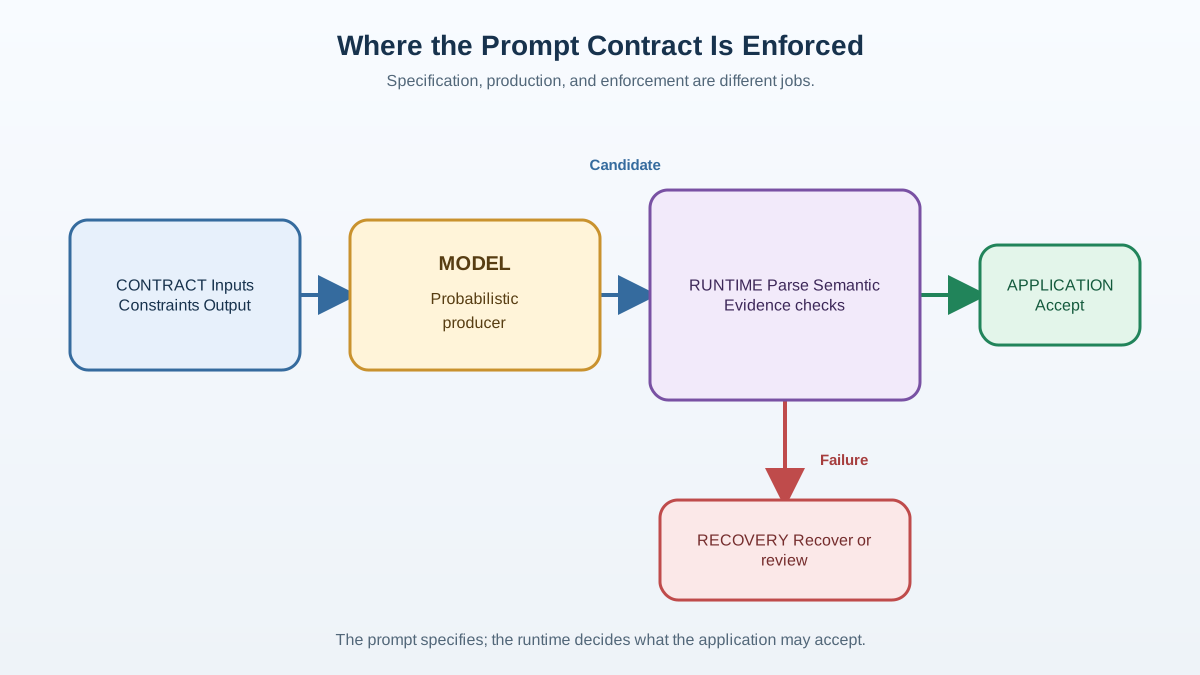
Here is the reasoning jump that trips up experienced engineers. A prompt can express a contract, but it cannot guarantee one. The model is a probabilistic implementer of your specification, not a compiler. It will usually comply, sometimes drift, and occasionally produce output that satisfies the letter of the contract while violating its intent.
That means "failure behavior" has two distinct halves, and conflating them is the source of most silent production failures:
- What the model should emit when it cannot comply — the refusal path, the fallback category, the low-confidence marker.
- What the application does when the model does not emit that — parse validation, semantic checks, evidence checks, and the recovery or routing decision.
The prompt is the behavioral specification. The model is the probabilistic producer. The runtime validator and recovery path are the enforcement layer. A contract without an enforcement layer is a hope with better formatting.
This distinction is not academic. It is exactly what the trace table later in this article exposes: an output that passes schema validation and still gets the category wrong. No amount of prompt wording prevents that class of failure. Only the enforcement layer catches it.
Knowledge check
Check your understanding
Answer this question before you continue.
Specificity Is a Budget, Not a Virtue
The common over-correction is to pile on instructions. More rules feel like more control. They are not. Competing or redundant rules create ambiguity the model resolves unpredictably, and you will not know which rule it chose until you inspect the output.
I have seen 40-line prompts where three rules quietly contradict each other — "be concise" next to "explain your reasoning in detail" — and the model silently picks one per run. The prompt looked thorough. It was underspecified.
Three habits help:
- Prefer positive, testable constraints over negations. "Do not include filler words, preambles, or unnecessary explanations" beats "be concise," because you can check it. When negation is unavoidable, name the exact thing to avoid rather than the general category.
- Separate task specification from persona framing. Persona is the weaker lever. "You are a world-class expert" does less work than a precise output contract, and its effect varies across models. Do not let persona carry the contract.
- Trace every line to a purpose. Each line should map to an input, a constraint, an output requirement, or a failure path. If it maps to none of those, cut it.
Every line in the prompt should be traceable to an input, a constraint, an output requirement, or a failure path. If it is none of those, it is noise competing for attention.
Specificity is allocation, not accumulation. Spend the budget where the contract needs precision.
Knowledge check
Check your understanding
Answer this question before you continue.
Examples and Reasoning Scaffolds as Specification
Few-shot examples encode the output contract more precisely than prose can, especially for format and edge-case handling. A single well-chosen example often does more than three paragraphs of format description.
The mistake is building an example set that only shows the happy path. Include at least one example that demonstrates the failure path — the "insufficient information" case, the out-of-scope input, the contradictory ticket. That is where most example sets are incomplete, and it is exactly the behavior you need to be reliable.
Reasoning scaffolds — requesting intermediate steps before the final answer — are a different tool with a different cost profile. They help on multi-step analytical tasks where the model benefits from working through structure. They hurt on simple extraction, where they add latency, tokens, and noise without improving the answer. Match the scaffold to the task; do not apply it by default.
Contrastive examples are underused. Showing a bad output next to a good one is often more effective than describing the difference in words, because the model can compare shapes directly rather than infer a rule from prose.
The tradeoff is real. Examples cost tokens and can over-anchor the model to surface patterns — it may copy the example's phrasing instead of generalizing the rule. Prose constraints generalize better but specify less precisely. Use examples for format and edge cases; use prose for the invariants that must hold across all inputs.
Making the Contract Observable
This is where prompt design stops being writing and becomes engineering. A contract you cannot check is a wish.
Structured output converts a soft expectation into a hard validation boundary. JSON, or any parseable shape, lets your code decide whether the model complied. Prefilling the response — starting the assistant turn with an opening brace, where the API supports it — reduces preamble and forces the response to begin inside the contract.
The validation layer is the part most teams skip. Parse the output, check required fields and types, and treat a parse failure as a first-class error rather than a retry-and-hope. A retry loop that hides contract violations is worse than no retry, because it converts a visible design problem into an invisible one.
A small trace table is the debugging artifact that makes prompt failures reproducible:
| Input | Raw output | Validation | Action |
|---|---|---|---|
| Clean ticket | valid JSON, category=billing | pass | return |
| Empty body | valid JSON, category=other, conf=0.0 | pass | return |
| Contradictory fields | prose paragraph | parse fail | log, surface error |
| Out-of-scope | valid JSON, conf=0.9, wrong category | schema pass, semantic fail | flag for review |
The third row is the important one. An unparseable output is a signal about the prompt, not just about the model. It tells you the contract was not specific enough, or the input class was never covered. Read it that way.
Failure Paths: Designing for the Bad Input
Failure behavior is a design surface, not an afterthought. Silent wrong answers are more expensive than visible refusals, because a refusal is observable and a confident fabrication is not.
Three failure classes matter:
- Bad input — missing or contradictory evidence.
- Bad output — the response violates the contract.
- Bad confidence — a plausible but unsupported answer.
Design the refusal. An explicit "insufficient information" response is a feature, not a weakness. It is observable, it is actionable, and it stops the pipeline from propagating a guess downstream.
Then distinguish recoverable from terminal failure. Recoverable: retry with more context, or fall back to a narrower prompt. Terminal: surface to the user or the caller. Treating every failure as recoverable produces retry storms that mask the real problem.
The most common mistake is treating every failure as a prompt-wording problem. Often the real cause is missing input or an underspecified contract. If the failure is a retrieval or data problem, no amount of instruction rewriting fixes it. Rewriting the prompt to compensate for missing evidence just teaches the model to guess more fluently.
From Failure Signal to Next Action
Categories are not a repair loop. The useful move is to map each observed failure to the layer that owns it, then act there. This table is the diagnostic step that turns a trace into a fix:
| Failure signal | Likely layer | Next action |
|---|---|---|
| Output does not parse | Prompt contract or model drift | Tighten the output contract; add a bounded repair retry, then surface if it repeats |
| Parses but wrong category | Semantic gap or missing evidence | Check whether the input contained the evidence; if not, fix retrieval, not wording |
| Confidence high, answer unsupported | Enforcement layer | Add an evidence check; treat confidence as a claim to verify, not proof |
| Refusal on a valid input | Over-tight failure path | Loosen the refusal condition; add a positive example for that input class |
| Repeated failure on the same input | Terminal | Stop retrying; route to a human or a narrower fallback |
Two rules keep this honest. First, confidence is an output claim, not a measurement. A model-reported float is a self-report; if you need calibrated confidence, you have to evaluate it against labeled outcomes. Second, retrying with "more context" only helps when the missing thing is context. If the evidence does not exist, retrying just spends tokens to produce a more fluent guess.
Knowledge check
Check your understanding
Answer this question before you continue.
Evaluating the Interface Before It Becomes a Pipeline
You do not need a full evaluation harness to test a prompt interface. You need a small labeled set of inputs that includes the ugly cases: empty, contradictory, out-of-scope, and adversarial. Five deliberately bad inputs will expose more than fifty clean ones.
Score against the contract, not against vibes. Four checks separate shape from trustworthiness:
- Syntactic — does the output parse and satisfy the schema? Test: a JSON parser plus a schema validator.
- Semantic — is the category or answer actually correct? Test: a labeled set with known-correct outputs.
- Evidence — is the claim supported by the provided input? Test: check that cited or implied evidence exists in the source.
- Failure routing — does bad input produce the intended refusal or fallback? Test: feed known-bad inputs and assert the expected path.
Each check has a different owner. A syntactic failure points at the prompt contract. A semantic failure points at the task definition or the evidence. An evidence failure points at the enforcement layer. A routing failure points at the failure path. Fixing the wrong layer is how teams spend a week rewriting a prompt that was never the problem.
Version the prompt like code. A prompt change without a re-run against the set is an untested change, and prompt edits have a way of fixing one case while breaking three others.
Ship the prompt when it fails visibly and predictably, not when it succeeds impressively.
There is a boundary here worth naming. Once inputs must be assembled dynamically, retrieved, or routed at runtime, the problem has moved from prompt design to context assembly and orchestration. The contract you wrote becomes the interface those systems must honor. The prompt is no longer the whole system; it is one component with a declared boundary.
The Next Move
Take one prompt currently running in a real application. Write down its four-part contract: inputs, constraints, output, failure. Then run it against five deliberately bad inputs — empty, contradictory, out-of-scope, adversarial, and one that is technically valid but semantically wrong.
The gaps that appear are the design work. They will show up as parse failures, silent category errors, or confident answers with no evidence behind them. Each gap is a line you did not specify.
Fix the contract, not the wording. Then re-run the same five inputs and confirm the failures are now visible and predictable. That is the moment the prompt stops being a request and becomes an interface — the artifact that survives when the prompt becomes part of a larger context-assembly or orchestration system.
Knowledge check
Final check
Finish the article by checking the ideas you just learned.
References
Research updated Sep 11, 2026


