
Reframing and Attention Prompting: Step-Back, Rephrase-and-Respond, and System 2 Attention
That failure breaks the "bad answer means bad instruction" reflex. Sometimes the instruction is fine, and the bottleneck sits somewhere else: the model…

Key topics
The model has the facts. The instruction is clear. The answer is still wrong.
That failure breaks the "bad answer means bad instruction" reflex. Sometimes the instruction is fine, and the bottleneck sits somewhere else: the model committed to the wrong reading of the question, or it read the question correctly and then weighted the wrong tokens. Reframing prompting is the family of techniques that attacks that bottleneck directly — by changing the problem representation or the attention distribution before the model is allowed to answer.
The practical question is not whether these methods work. It is where to spend a second call, and how to know the gain is real.
Three Levels of Intervention
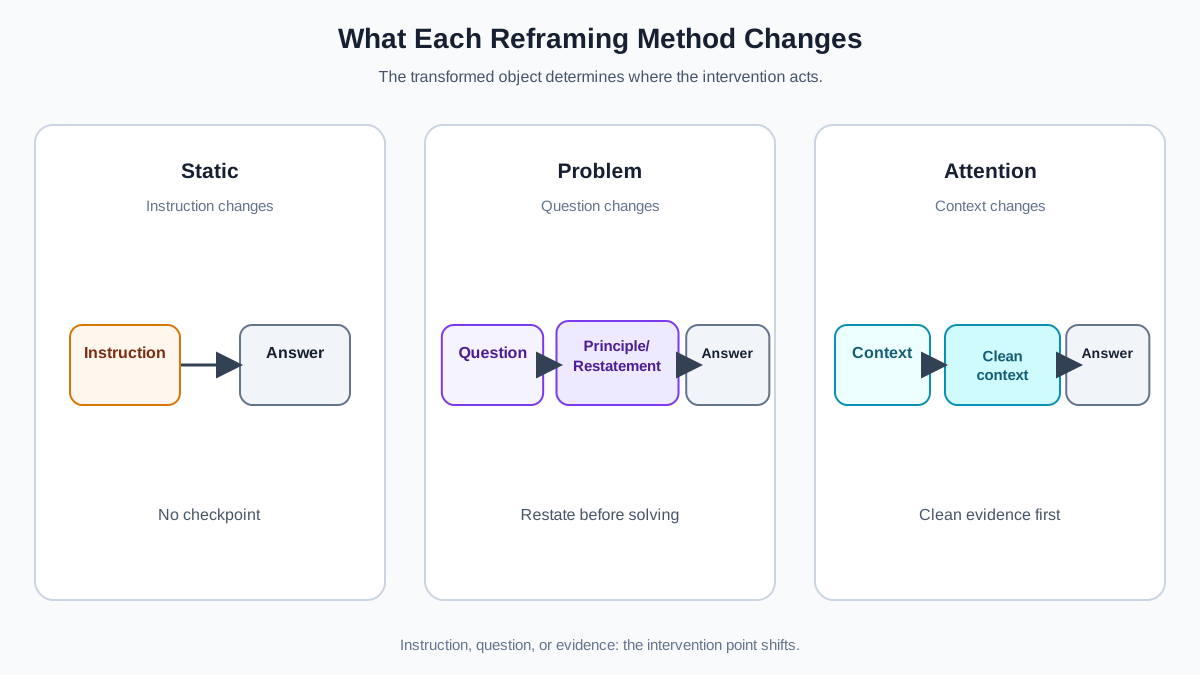
Before comparing techniques, fix the taxonomy. "Reframing" gets used loosely, and the looseness hides a real architectural difference.
- Static instruction reframing rewrites the prompt before inference. Itemized instructions, explicit output constraints, low-level output patterns. One call, no intermediate artifact.
- Generated problem reframing produces an intermediate representation of the question — an abstraction, a restatement — and answers against it. Two calls, one artifact.
- Attention prompting produces an intermediate representation of the evidence — a cleaned or reweighted context — and answers against that. Two calls, one artifact.
This article focuses on the generated two-pass methods: step-back, Rephrase-and-Respond, and System 2 Attention. Static reframing is the baseline contrast — it is what you already do, and it is often enough. The two-pass methods exist for the cases where it is not.
Knowledge check
Check your understanding
Answer this question before you continue.
The Failure Mode These Techniques Target
Two failure signatures look identical in a dashboard and require different fixes.
Representation failure. The model misreads what is being asked. The question is underspecified, carries an implicit constraint, or admits a plausible-but-wrong parse. The model answers the question it inferred, not the one you meant.
Attention failure. The model reads the question correctly but weights the wrong tokens. Supplied context conflicts with parametric knowledge, and the model prefers its priors. Distractor sentences in a long context pull probability mass away from the evidence that matters.
A single final generation can mitigate both through better wording — that is what static reframing does. What it cannot do is expose whether the model's representation or evidence selection was correct before it answered. There is no independently inspectable revision stage. The premise is fixed the moment generation starts, and you only see the output.
That missing stage is the bridge to multi-call methods. If you already write prompt contracts that specify objectives, inputs, constraints, and acceptance criteria, you have defined the interface. A contract does not guarantee the model resolves the task the way you intended. The two-pass methods buy you a checkpoint between interpretation and answer.
This is where the System 1 / System 2 framing earns its keep — as a loose but useful abstraction. System 2, in this literature, is any approach that generates intermediate tokens before the final answer: chain-of-thought, tree-of-thoughts, branch-solve-merge, and the three techniques here. The definition is deliberately broad. What matters operationally is that intermediate tokens cost latency, and that cost is why most of these methods never reach production.
Step-Back: Reframing Toward the Principle
Step-back prompting asks for the general principle or abstraction first, then answers the concrete question using it. The intermediate abstraction is the artifact that changes the second call.
Why it works mechanically: the first call moves the model into a region of the distribution where the relevant concepts are already active. The second call conditions on a better starting point rather than reconstructing the principle from scratch while also answering.
The failure mode is sharp. Step-back on a task with no underlying principle produces a plausible-sounding abstraction that actively misleads the final answer. Ask a model to "identify the governing principle" behind a lookup question and it will invent one, then answer through the invention. Step-back belongs on tasks where a principle genuinely exists — physics problems, multi-hop reasoning over rules, anything with a stable underlying structure.
Step-back is a generated reframe, but it is not the same as static instruction rewriting. The static version — itemize, constrain, use low-level patterns — changes the prompt text. Step-back changes the question the model answers. That distinction matters when you debug: a static reframe that fails means your wording was wrong; a step-back that fails means the abstraction was wrong.
Knowledge check
Check your understanding
Answer this question before you continue.
Rephrase-and-Respond: Making the Model Restate the Question
Rephrase-and-Respond (RaR) makes the model rewrite the question with added elaboration, then answer the rewritten question. The rephrase is the intermediate token budget that forces an explicit interpretation.
There are two variants, and the distinction is the whole point:
- One-step RaR: a single combined prompt that asks the model to rephrase and answer.
- Two-step RaR: two separate calls — rephrase, then answer the rephrased question.
The two-step variant is the one that shows large gains on reasoning tasks that are hard for the baseline model. In the distillation study that reproduced these methods, two-step RaR moved exact-match accuracy on a coin-flip reasoning task from a 56% baseline to 77%, while one-step RaR landed at 58% — barely above baseline.
Why the split matters: a combined prompt lets the model answer while it is still rephrasing. The interpretation never gets committed, so the benefit collapses. Two calls force the interpretation to be fixed before the answer is generated.
Where it pays off: underspecified questions, questions with implicit constraints, and tasks where the model's first reading is a plausible but wrong parse. Where it fails: the rephrase drifts. If the model silently changes the question's scope or drops a constraint, the second call answers a different problem with full confidence. This is why you log the rephrase.
Knowledge check
Check your understanding
Answer this question before you continue.
System 2 Attention: Rewriting the Context Before Answering
System 2 Attention (S2A) intervenes on the input distribution, not the instruction. The first call regenerates the context, stripping irrelevant or biasing content. The second call answers against the cleaned context.
This is the structural difference from step-back and RaR: those change the question; S2A changes the evidence the question is answered against.
The problem it targets is context faithfulness. When supplied context conflicts with the model's parametric knowledge, the model often prefers its priors. A documented way to increase faithfulness is to reframe the context as a narrator's opinion and ask for that narrator's view — "according to Bob's statement, ..." — which forces attention onto the provided text rather than the model's memory. Counterfactual demonstrations, which include false facts in the examples, are a related technique. Abstention-oriented prompting, which gives the model an explicit way to say the context does not contain the answer, is a third.
These are research findings on specific datasets and tasks. They are worth knowing; they are not a universal fix.
The failure mode is lossy filtering. The rewrite deletes the one sentence that mattered, and the loss is invisible unless you log the intermediate context. S2A on a short, clean context is pure overhead. It earns its cost on distractor-heavy inputs and knowledge-conflict situations.
A Worked Trace
Abstractions are cheap. Here is one compact trace that shows why the failure signature determines the method.
Task: A support-triage question. The context contains a policy paragraph, a distractor paragraph about an unrelated product, and one sentence stating the actual refund window. The question asks whether a specific order qualifies.
Baseline output: The model answers from its general knowledge of refund policies, ignoring the stated window. Failure signature: attention failure. The question was read correctly; the evidence was not weighted.
Wrong fix: Step-back. Asking for "the governing principle of refund eligibility" produces a plausible abstraction about consumer protection, and the second call answers through that abstraction — still ignoring the stated window. The principle was invented, not extracted.
Right fix: S2A. The first call regenerates the context, dropping the distractor paragraph and preserving the refund-window sentence. The second call answers against the cleaned context and gets the window right.
Artifact-corruption variant: Suppose the S2A rewrite also drops the sentence stating the order date, because it looked like metadata. The final answer is now confidently wrong in a new way. Nothing in the final-answer metrics flags this — the answer is fluent and specific. Only the logged intermediate context reveals the lost span.
That trace is the whole argument for artifact-level auditing. Final accuracy alone cannot distinguish "the method worked" from "the method corrupted the input and got lucky."
Choosing Between Them: A Decision Table
The decision axis is what is broken. Pick the technique by the failure signature, not by which one sounds most sophisticated.
| Failure signature | Technique | Intermediate artifact | When it fails |
|---|---|---|---|
| Task has a governing principle the model is not applying | Step-back | General principle or abstraction | No real principle exists; the abstraction misleads |
| Question is ambiguous or under-specified | Rephrase-and-Respond (2-step) | Rewritten question | Rephrase drifts or drops a constraint |
| Context conflicts with priors, or distractors dominate | System 2 Attention | Cleaned context | Rewrite deletes critical evidence |
When not to use any of them: single-fact lookup, classification with a clear label set, latency-critical paths, and tasks where the baseline already saturates. Adding a second call there buys variance, not accuracy.
There is a distillation escape hatch worth knowing before you commit to a permanent two-call architecture. System 2 behavior can sometimes be distilled back into a single-pass System 1 model, recovering much of the accuracy at a fraction of the cost. In the same study, a distilled System 1 model reached 75.7% on the coin-flip task — close to the 77.2% two-step teacher — without the second call. The honest limit: distillation results are task-specific and require training data and infrastructure most teams do not have on day one. It is a reason to keep the intermediate artifacts, not a reason to plan around it.
Knowledge check
Check your understanding
Answer this question before you continue.
Auditing the Intermediate Artifact
The intermediate artifact is not a reasoning trace. It is a transformed input, and it can be wrong in ways the final answer hides. Audit it against preservation invariants.
For RaR, check that the rephrase preserves:
- Entities and referents. Names, IDs, and pronouns still point at the same things.
- Scope and quantifiers. "All," "at least one," and "exactly one" survive intact.
- Quantities and units. Numbers, dates, and thresholds are unchanged.
- Negations. A dropped "not" inverts the question.
- Requested output type. If the answer must be a number, the rephrase still asks for a number.
For S2A, check that the rewritten context preserves:
- Answer-bearing spans. Every sentence the correct answer depends on is still present.
- Constraint sentences. Rules, limits, and conditions are not filtered as "irrelevant."
- Conflict markers. If the original context contradicted the model's priors, the contradiction is still visible.
Run these as a programmatic diff where the task allows it — span overlap, entity matching, numeric extraction. Where it does not, sample the intermediates and read them. The point is not to verify that the model "reasoned correctly." The point is to verify that the transformation did not silently change the problem.
A two-call method that improves final accuracy while corrupting its intermediate artifact is a method that will fail unpredictably on inputs you have not seen yet. Audit the artifact, not just the answer.
Measuring the Trade: Latency, Cost, and Variance
Build a small labeled set of the specific failures you are trying to fix. Twenty to fifty hard cases beats a thousand easy ones for this decision, because easy cases saturate and tell you nothing about the boundary you are probing. Treat this as a screening experiment, not proof of a production effect.
Measure per variant:
- Accuracy on your hard set.
- p50 and p95 latency. The tail is what users feel.
- Token cost per request, including the intermediate call.
- Run-to-run variance across repeated trials at non-zero temperature.
Compare baseline and variant on the same examples, paired. Report the per-example score difference and a confidence interval or bootstrap interval around it, rather than eyeballing two aggregate numbers. Separately, report the flip rate: how often a given example changes from correct to incorrect across repeats. A method that is 8 points better on average but flips 15% of examples between runs is worse than a single call you can reason about. The average hides the failure; the flip rate exposes it.
Log the intermediate artifact — the step-back abstraction, the rephrase, the rewritten context. Without it you cannot tell whether a failure came from the reframe or the final answer. When a two-call variant underperforms, the intermediate tells you which call to fix.
The decision rule: adopt the technique only if the paired accuracy gain clears the uncertainty interval, the flip rate stays acceptable, and the p95 latency still fits the product's interaction budget. If the gain is inside the noise, you have added cost and complexity for nothing.
The Next Move
Pick one hard task where the baseline fails and you suspect a representation or attention problem. Build a single-call baseline and a two-call variant. Log both intermediates. Run each twenty times at your production temperature. Compare paired accuracy, p95 latency, and the flip rate across runs.
Then read the intermediates. If the rephrase dropped a constraint, or the cleaned context lost an answer-bearing span, you have found the real failure — and it is not the one the final-answer metrics were showing you.
If the gain clears the uncertainty interval and the artifact audit passes, keep the second call. If it does not, you have learned something more valuable than a new technique: you have found the boundary where the extra call stops paying for itself.
Knowledge check
Final check
Finish the article by checking the ideas you just learned.
References
Research updated Sep 11, 2026


