
Role, Context, Style, and Negative Constraints: When Standard Prompting Techniques Matter
A prompt that grew from three lines to thirty is not a better prompt. It is a prompt nobody has tested.

Key topics
A prompt that grew from three lines to thirty is not a better prompt. It is a prompt nobody has tested.
You know the scene. The first version was a sentence and a half. The output was close but not quite right, so you added a role line. Then a tone note. Then a "do not" rule. Then another. Six weeks later the prompt reads like a legal contract drafted by a committee, and the outputs still drift between runs. Every line felt necessary when you added it. Almost none of them were.
The hidden question underneath the drift is simple: which of these lines is load-bearing? Answer it and the prompt shrinks. Ignore it and you keep adding rules to a structure that is already fighting itself.
The Prompt That Grew a Costume
Prompt bloat is what happens when you treat every bad output as a missing instruction. The model returned a bulleted list when you wanted prose, so you add "do not use bullet points." It was too terse, so you add "be thorough and engaging." It sounded generic, so you add "you are a world-class expert." Each addition feels like progress. The prompt gets longer, the outputs get marginally better for a day, then drift again, and you add more.
The problem is that you never tested whether the line you added was the thing that fixed the output. You changed two variables at once and credited the one that sounded most professional.
Here is the test that cuts through it. Take the prompt. Remove one line. Rerun the same input. Compare the output.
If nothing observable changes, the line was decoration. If the output changes in a way you care about, the line was load-bearing. That is the whole method, and it is brutal in the best way, because it does not care how much the line cost you to write or how authoritative it sounds.
The smallest instruction set that produces the target behavior is the correct one. Every extra line is a new surface for conflict, a new thing to maintain, and a new reason the next failure will be hard to isolate.
This is not an argument for terse prompts. It is an argument for tested prompts. A long prompt where every line has been shown to change behavior is fine. A short prompt full of untested assumptions is not.
Knowledge check
Check your understanding
Answer this question before you continue.
Four Instruction Types and What Each One Controls
Before you can run the removal test, you need to know what kind of line you are looking at, because different categories fail in different ways and require different evidence.
| Type | What it controls | Typical failure mode |
|---|---|---|
| Role | Perspective, vocabulary, default register | Blamed for problems it did not cause |
| Context | The facts and audience the model cannot infer | Diluted by irrelevant material |
| Style | Surface form: tone, length, format | Vague words that cannot be verified |
| Negative constraint | Prohibited outputs | Names an abstraction instead of a pattern |
Role sets the frame the model answers from. It shifts vocabulary and register. It rarely changes whether the task is done correctly.
Context supplies the evidence. This is the category most likely to change the answer itself, because it changes what the model has to work with.
Style controls the surface. Tone, length, structure, reading level. This is the cheapest category to verify because you can check it mechanically.
Negative constraints prohibit specific outputs. They work when they name a concrete, recognizable pattern. They fail when they name an abstraction.
These categories overlap in real prompts, and that is fine. The classification is a diagnostic tool, not a taxonomy to enforce. Its job is to tell you what evidence would prove a given line is doing work.
Role and System Instructions: What They Change and What They Do Not
Role prompting is the most overrated technique in the standard toolkit, and the most misunderstood. It reliably shifts register, vocabulary, and framing. It is unreliable as a correctness lever. When a role line seems to fix a factual problem, something else is usually doing the work.
The research on role-playing models this split directly. Work on role-playing benchmarks separates two problems that a single persona line tends to blur: imitating a speaking style, and possessing role-specific knowledge. A prompt that says "you are Sherlock Holmes" buys you the cadence. It does not buy you the deductions. If the task needs knowledge the model does not have, no persona will supply it.
System-level role instructions carry more weight than the same sentence buried in a user turn, but the mechanism is still context conditioning. It is not a mode switch. The model is not entering a different operating state; it is reading a sentence that shapes the distribution of likely continuations.
The practical decision rule: keep a role line when you can name the observable output change it produces. Cut it when you cannot.
The common mistake is stacking personas. "You are a senior engineer and a patient teacher and a ruthless editor" does not produce a senior engineer who teaches patiently and edits ruthlessly. It produces a muddled average of three registers, and the model picks whichever one fits the moment. One role, one job.
Context: The Instruction Type That Most Often Changes the Answer
Context is the highest-leverage category, and its failure modes are almost never about wording. They are about placement, relevance, and the model's willingness to commit.
Context changes the answer because it changes the evidence available. That sounds obvious, but it has a sharp consequence: if removing a context block does not change the output on your test inputs, it is not context. It is noise taking up space.
Placement matters more than most people expect. A relevant sentence buried in the middle of a long document can be retrieved but not used. Anthropic's own evaluation of long-context retrieval found that a model would detect an embedded sentence and still decline to answer from it, reporting that the document did not contain enough information. Adding a short directive to surface the relevant evidence first flipped the outcome dramatically on the same inputs. The model had the fact. It needed a nudge to commit to it.
That is the mechanism: context supplies evidence, and a framing instruction changes whether the model treats that evidence as sufficient.
Distinguish two kinds of context. One supplies facts. The other supplies audience and purpose. Both are useful, but only the first is usually load-bearing for correctness. Audience context changes how the answer is pitched, not whether it is right.
The failure mode is dumping everything relevant into the prompt and calling it context. That dilutes the signal, makes the prompt harder to debug, and gives the model more opportunities to anchor on the wrong passage. Relevance is not the same as usefulness.
Knowledge check
Check your understanding
Answer this question before you continue.
Style Control: The Cheapest Constraint to Verify
Style is where you get the fastest feedback loop, which makes it the best place to practice the removal test.
Style instructions are verifiable. Word count, format, reading level, and structure can all be checked mechanically. That means you can build a fixed input set, run the prompt, and measure whether the style constraint held.
The problem is that most style instructions are not operationalized. "Professional," "engaging," and "concise" are not properties you can check. They are moods. Two reviewers will disagree about whether a given output satisfies them, which means you cannot tell whether a prompt change helped. Replace the mood word with a checkable property. "Concise" becomes "under 150 words." "Professional" becomes "no contractions, no exclamation points." Now the constraint has a pass/fail.
One interaction worth knowing: a strict format constraint can degrade reasoning quality if it forces the model to commit to structure before it has worked out the answer. If you demand a rigid JSON schema and the task requires multi-step reasoning, consider letting the model reason first and format second. The format is not free.
State style constraints as observable properties, and test them on a fixed input set rather than a single lucky run.
Knowledge check
Check your understanding
Answer this question before you continue.
Negative Constraints: Useful, Fragile, and Easy to Overuse
Negative constraints behave differently from positive ones, and the difference is not cosmetic.
A prohibition works best when it names a specific, recognizable pattern the model can detect in its own output. "Do not use the phrase 'it's worth noting'" is checkable. The model can scan its draft and remove the pattern. "Do not hallucinate" is not checkable. The model has no reliable way to detect the thing you are forbidding, so the instruction does nothing except occupy tokens.
Abstract prohibitions often just shift the failure to a nearby form. Tell a model not to be biased and it may become evasive instead. You have not removed the problem; you have moved it somewhere harder to see.
Prohibitions can also conflict with positive instructions. When they do, the model resolves the conflict unpredictably, and that unpredictability is a common source of what looks like inconsistency across runs. If you say "be thorough" and "do not exceed 100 words," you have created a tension the model will resolve differently depending on the input.
The fix is to prefer a positive specification when both would work. "Include battery life, charging speed, and comfort" is easier to evaluate than "do not mention pricing or competitors." The positive version tells the model what to build. The negative version only tells it where the walls are.
When a negative constraint is genuinely necessary, pair it with the positive alternative. Give the model a target, not just a prohibition.
Knowledge check
Check your understanding
Answer this question before you continue.
Building the Smallest Useful Instruction Set
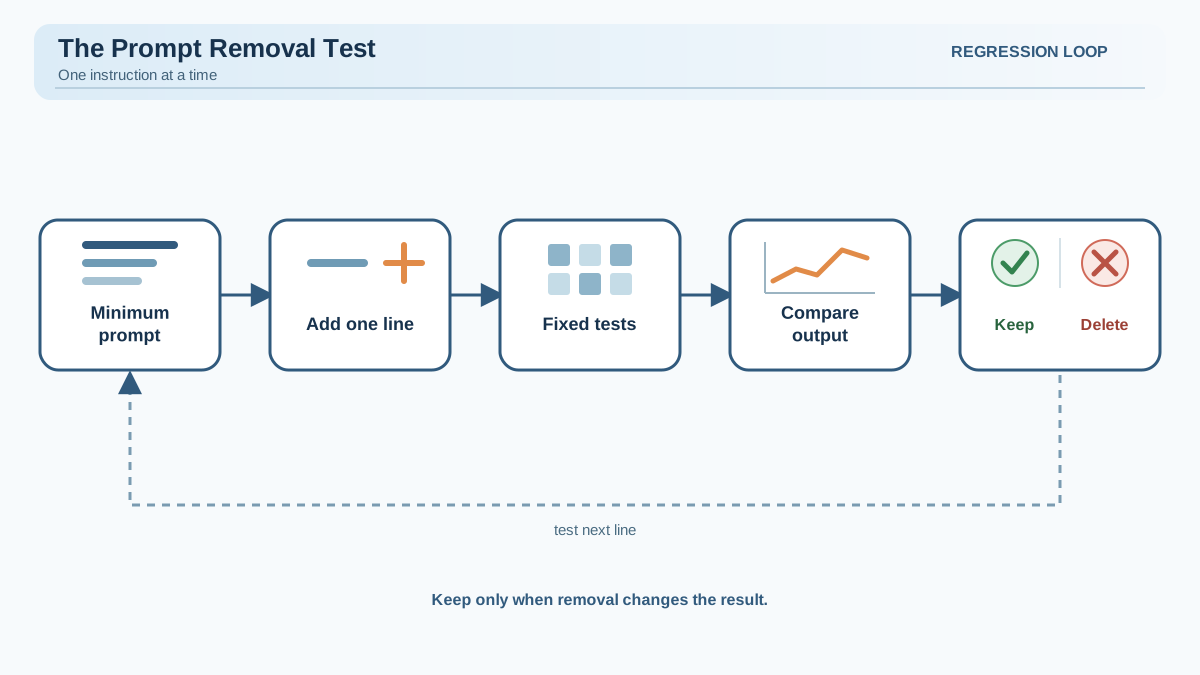
Here is the procedure I would run on any prompt currently in production.
Step 1. Write the target behavior as an observable property. Not "the output should feel expert." Something like "every claim cites a source from the provided context."
Step 2. Build a small fixed test set. Three to five inputs that previously produced drift. This is your regression suite. Without it, every change is a guess.
Step 3. Start from the minimum prompt that could plausibly work. Task plus essential context. Nothing else.
Step 4. Add one instruction at a time. After each addition, rerun the full test set and record whether the output changed in the intended direction.
Step 5. Delete any line whose removal does not change the output. Keep the rest.
The cost of skipping this is prompt debt, and it accumulates the same way code debt does. The difference is that there is no compiler to catch it. A dead line in a prompt does not throw an error. It just sits there, consuming attention, occasionally conflicting with a live instruction, and making the next failure harder to trace.
I have watched prompts where half the lines could be deleted with zero change in output. Nobody noticed because nobody ran the removal test. The lines had been there so long they looked like requirements.
When These Techniques Stop Being Enough
There is a boundary where instruction design stops being the right layer to fix, and recognizing it saves weeks.
If the prompt needs different instructions depending on the input, the problem is routing, not wording. You need a classifier or a dispatch step, not another conditional clause.
If the prompt needs facts that change per request, the problem is retrieval and context assembly. No amount of prompt tuning will supply information the model does not have.
If you cannot tell whether a change helped, the problem is evaluation. Build the test set before you tune anything else.
The signal that you have hit the boundary: the prompt is stable, the test set is fixed, and the remaining failures are about missing information or missing control flow. At that point you are no longer debugging a prompt. You are debugging a system, and the fix lives in a different file.
Take one prompt you are using right now. List every instruction on its own line. Run the removal test on each line against three to five fixed inputs. Keep the line only if its removal changes observable behavior. What is left is your actual prompt. Everything you deleted was costume.
Knowledge check
Final check
Finish the article by checking the ideas you just learned.
References
Research updated Sep 11, 2026


